St. Patrick’s Day Spiritual Meaning: Symbols, Faith, and Sacred Traditions
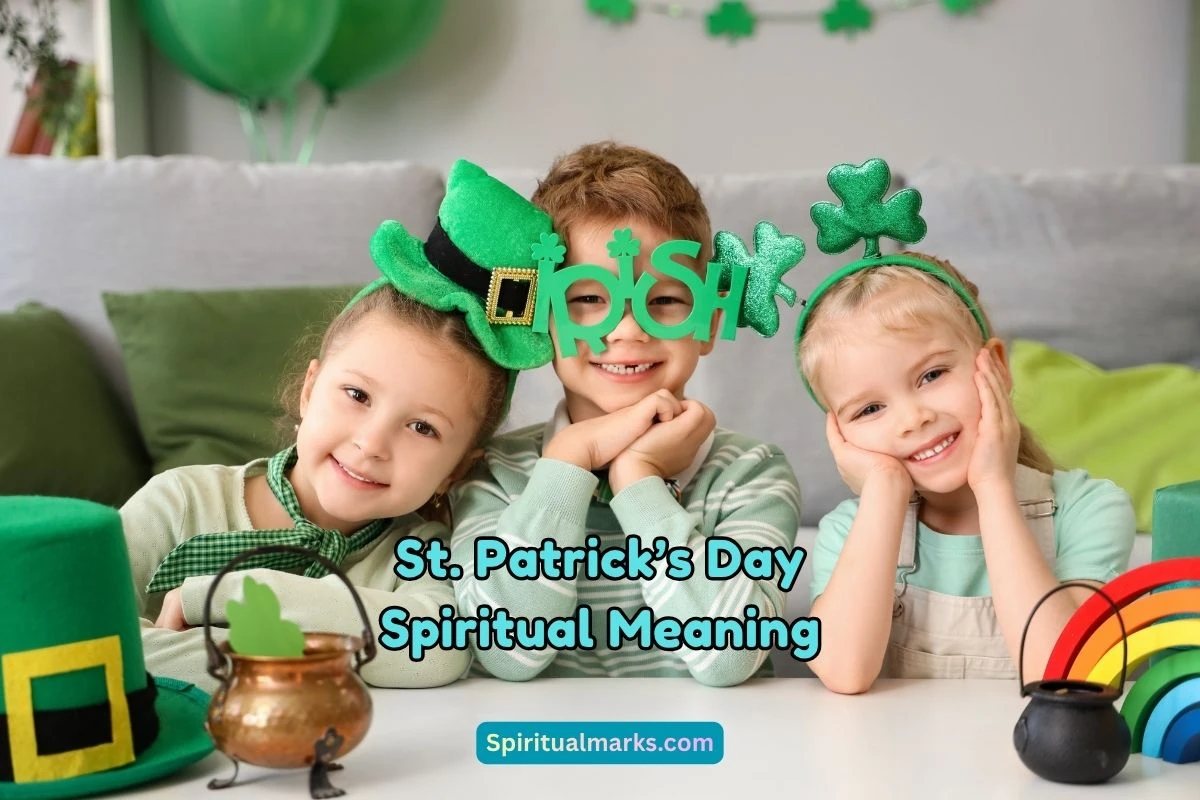
Every year on March 17th, millions of people wear green, attend parades, and raise a glass in celebration. But beneath the festivity lies something far deeper and far more sacred. St. Patrick’s Day carries a profound spiritual meaning that most people never pause to consider.
Saint Patrick was not Irish by birth. He was a kidnapped teenager, a slave, a fugitive, and ultimately one of history’s most transformative spiritual figures. His life was not a fairy tale. It was a raw, painful, and deeply human story of faith forged in suffering.
The holiday named after him is officially a Christian feast day, observed on the anniversary of his death in 461 AD. Long before it became a global cultural celebration, it was a day of prayer, fasting, and spiritual reflection within the Catholic and Celtic Christian traditions.
You may have grown up celebrating this day with shamrocks and parades. Yet the symbols attached to St. Patrick’s Day, including the three-leaf clover, the serpent, the Celtic cross, the color green, and the bonfire, all carry rich spiritual weight. Each one tells a story about the human soul’s relationship with the divine.
This blog post digs into the spiritual meaning of St. Patrick’s Day in full. Whether you follow the Christian faith, draw from Celtic spiritual traditions, or simply feel drawn to the deeper meaning behind ancient symbols, this exploration will resonate with you.
Key Takeaways
- St. Patrick’s Day is first and foremost a Christian feast day, commemorating the death of Saint Patrick, the patron saint of Ireland, on March 17th, 461 AD.
- The shamrock holds deep Trinitarian symbolism, used by Patrick himself to explain the mystery of the Holy Trinity to the Irish people.
- Saint Patrick’s life journey from slavery to spiritual leader carries powerful lessons about divine purpose, resilience, and redemption.
- The Celtic Cross and the serpent symbol connected to Patrick represent the triumph of light over darkness and the casting out of spiritual evil.
- Green, the color of this holiday, carries sacred meaning tied to growth, renewal, life, and the eternal nature of the spirit.
Who Was Saint Patrick? The Spiritual Story Behind the Man
Before you can grasp the spiritual meaning of St. Patrick’s Day, you need to understand the man himself. Most people know his name. Very few know his actual story.
Saint Patrick was born in Roman Britain, likely around 385 AD. At the age of sixteen, he was captured by Irish raiders and taken to Ireland as a slave. For six years, he herded sheep on the cold hillsides of Ireland. He was alone, frightened, and cut off from everything he had ever known.
This period of isolation became his spiritual crucible. Patrick himself wrote in his memoir, Confessio, that he prayed up to a hundred times a day during his captivity. He described how his faith grew stronger in direct proportion to his suffering. Hardship did not break him. It built him.
After six years, Patrick received what he believed was a divine vision. A voice told him to leave Ireland and that a ship was waiting for him. He escaped, walked nearly 200 miles to the coast, and found a vessel that carried him back to Britain. His return was not the end of the story. It was the beginning of his true mission.
Patrick later experienced another vision in which the Irish people cried out for him to return. He heard their voices in his sleep, calling him back to the very land that had enslaved him. He responded. He trained for the priesthood, was consecrated a bishop, and returned to Ireland around 432 AD, not as a slave but as a missionary with a divine purpose.
His ministry in Ireland lasted roughly thirty years. He baptized thousands, ordained priests, established monasteries, and transformed the spiritual landscape of an entire nation. He died on March 17th, 461 AD, and the Church declared that date his feast day in recognition of his life’s work.
The spiritual lesson embedded in Patrick’s story is unmistakable. Suffering can be sacred. Captivity can become a calling. The very place of your greatest pain can become the place of your greatest purpose.
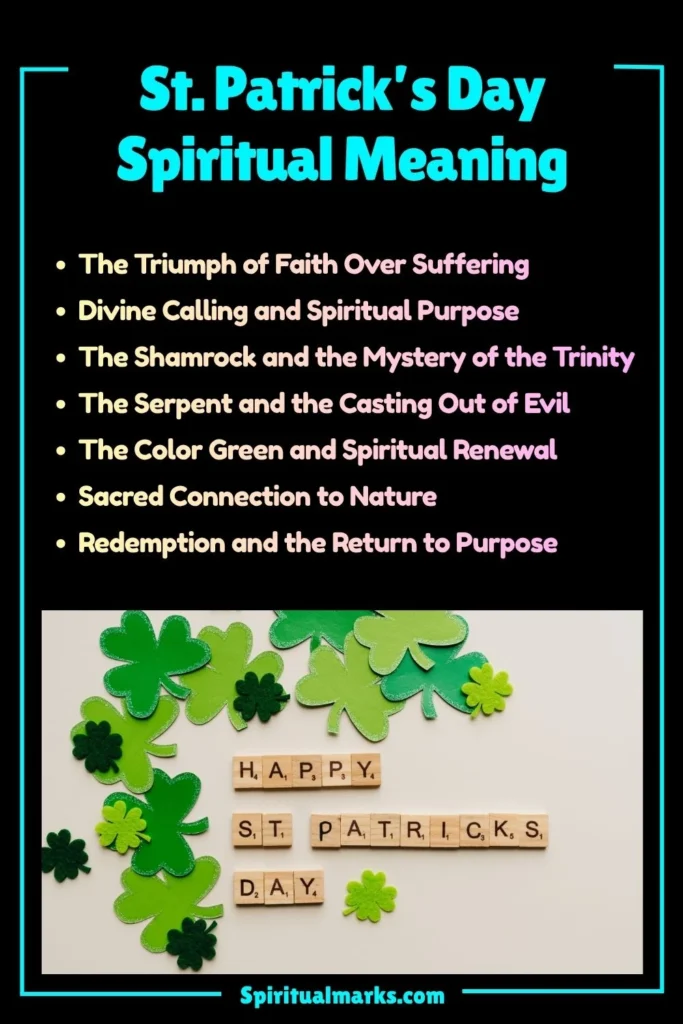
7 Spiritual Meanings of St. Patrick’s Day
1. The Triumph of Faith Over Suffering
The first and most foundational spiritual meaning of St. Patrick’s Day is the power of faith to sustain the human soul through suffering. Patrick did not have an easy road. He was enslaved at sixteen, cut off from family, and forced into brutal labor in a foreign land.
Yet his response to suffering was not bitterness. It was prayer. His memoir, Confessio, describes a young man who turned inward when the outer world became hostile. He wrote, “The love of God and his fear grew in me more and more.” This spiritual discipline forged during captivity gave him the resilience to carry out one of history’s most unlikely missionary journeys.
Spiritual suffering has always been a transformative force in sacred traditions worldwide. Patrick’s story aligns closely with the biblical archetype of Joseph, who was sold into slavery before rising to become a source of salvation for others. The spiritual message is clear: your lowest point can become your greatest launching pad. St. Patrick’s Day celebrates that truth every year on March 17th.
If you are walking through a season of pain or confusion, Patrick’s story speaks directly to you. It does not promise the absence of hardship. It promises that faith can turn hardship into holy purpose. That is the living heart of this feast day.
2. Divine Calling and Spiritual Purpose
St. Patrick’s Day carries a powerful message about divine calling. Patrick did not choose his mission based on comfort or convenience. He chose it in response to what he believed was a direct call from God.
After returning to Britain, he could have settled into a normal life. He had every reason to distance himself from Ireland. Instead, he experienced what he described as a vision of the Irish people pleading for his return. He wrote that he heard their voices as if in a single cry: “We beg you, holy boy, to come and walk again among us.” That vision changed the direction of his entire life.
This aspect of St. Patrick’s story speaks to the spiritual concept of vocation, the idea that each person has a specific purpose they are called to fulfill. Patrick’s calling required him to return to the very place of his trauma. True spiritual calling often works this way. It does not lead you to safety. It leads you back to where your unique gifts are most needed.
The spiritual meaning here is deeply personal. St. Patrick’s Day is an annual invitation to ask yourself whether you are living in alignment with your own divine calling. Are you walking toward your purpose with the same courage Patrick showed? This feast day is a mirror held up to the soul.
3. The Shamrock and the Mystery of the Trinity
No symbol is more closely associated with St. Patrick’s Day spiritual meaning than the shamrock. According to tradition, Patrick used the three-leafed clover to explain the doctrine of the Holy Trinity to the Irish people. He showed how three distinct leaves could exist on a single stem, just as the Father, Son, and Holy Spirit are three distinct persons within one God.
Whether or not this story is historically documented, its theological depth is remarkable. The shamrock became a teaching tool, a natural object used to bridge the gap between ancient Irish reverence for nature and the Christian understanding of the divine. Patrick met the Irish people where they were. He used the created world to point toward the Creator.
The shamrock also carries Celtic symbolism that predates Christianity. The number three was considered sacred in Celtic tradition. The Celts saw power and completeness in trinities: land, sea, and sky; body, mind, and spirit; past, present, and future. Patrick’s use of the shamrock was therefore not a random choice. He was layering new spiritual meaning onto an already sacred symbol in a way the Irish people could receive.
On a deeper level, the shamrock teaches that unity can hold diversity. Three things can be distinct and yet completely one. This principle applies not just to theology but to the human experience of community, relationship, and inner wholeness. When you see a shamrock on St. Patrick’s Day, you are looking at a symbol of divine mystery made visible through the simplest of natural forms.
4. The Serpent and the Casting Out of Evil
One of the most famous legends surrounding Saint Patrick is that he drove all the snakes out of Ireland. Standing on a hilltop, he is said to have fasted for forty days and then banished every serpent from Irish soil. No snakes have lived in Ireland since the last Ice Age, so scholars widely interpret this story as spiritual allegory rather than literal history.
In both Christian and broader spiritual traditions, the serpent represents evil, temptation, and spiritual corruption. The Book of Genesis depicts the serpent as the agent of humanity’s fall. In many ancient cultures, serpents symbolize chaos, deception, and the forces that drag the soul away from truth and light.
Patrick’s act of driving out the serpents therefore carries a powerful spiritual meaning. It represents the casting out of darkness, the purification of a land, and the triumph of Christian faith over pagan spiritual forces. His forty-day fast mirrors Moses on Sinai and Jesus in the desert, both of whom fasted before receiving or exercising divine power. This is not coincidence. It is a deliberate theological statement about the nature of spiritual authority.
For you, the serpent symbolism of St. Patrick’s Day invites a personal question. What serpents inhabit your own inner landscape? What habits, fears, or spiritual corruptions need to be confronted and cast out? This feast day, viewed through this lens, becomes a call to spiritual cleansing and inner renewal. It challenges you to face what hides in the shadows of your own soul.
5. The Color Green and Spiritual Renewal
Green is the defining color of St. Patrick’s Day, but its spiritual significance runs much deeper than celebration aesthetics. In the spiritual vocabulary of both Christianity and Celtic tradition, green represents life, renewal, resurrection, and the eternal nature of the spirit.
Ireland’s landscape is famously, breathtakingly green. The country earned the nickname “the Emerald Isle” because of its lush, almost impossibly vibrant vegetation. For the Celtic people, this verdant beauty was not incidental. It was a visible sign of the land’s sacred vitality. Green was the color of a living earth, a land that breathed and pulsed with divine energy.
Within Christian spirituality, green is the liturgical color of Ordinary Time, the long seasons between major feasts when the Church focuses on growth, learning, and the slow deepening of faith. It is the color of spiritual growth in its quiet, steady form. Not the dramatic gold of Easter or the fiery red of Pentecost, but the patient, persistent green of a soul putting down roots.
St. Patrick’s Day falls in mid-March, right at the threshold of spring in the Northern Hemisphere. The timing is deeply symbolic. The earth is waking up after winter’s dormancy. New growth is pushing through frozen ground. The spiritual message is woven into the very season. March 17th is an invitation to renewal, a reminder that no winter of the soul lasts forever and that life always returns.
6. Celtic Spirituality and Sacred Connection to Nature
Saint Patrick did not erase Celtic spirituality. He transformed it. This is one of the most spiritually significant aspects of his legacy, and it gives St. Patrick’s Day a unique meaning that blends two powerful spiritual traditions.
The ancient Celts held a profound reverence for the natural world. They believed the divine was present in rivers, mountains, trees, and stones. Sacred wells were sites of prayer and healing. The rhythms of nature marked sacred time. This was not primitive superstition. It was a sophisticated spiritual worldview that recognized the immanence of the sacred in the physical world.
Patrick’s genius was that he worked with this worldview rather than against it. He baptized sacred wells rather than destroying them. He incorporated Celtic art forms, like the intricate knotwork patterns, into Christian contexts. The Celtic Cross, with its distinctive circle intersecting the traditional cross, is believed to represent Patrick’s blending of the Celtic sun symbol with the Christian cross.
This synthesis produced Celtic Christianity, a distinct and beautiful spiritual tradition characterized by its deep reverence for creation, its emphasis on personal spiritual experience, and its sense that heaven and earth are only a thin veil apart. Celtic Christians spoke of “thin places,” locations where the boundary between the physical and spiritual realms becomes almost transparent. St. Patrick’s Day honors this tradition and invites you to see the sacred hiding in plain sight within the natural world around you.
7. Redemption and the Return to Purpose
The final and perhaps most universally resonant spiritual meaning of St. Patrick’s Day is redemption. Patrick’s story is fundamentally a story of transformation. A boy taken as a slave returned as a liberator. A victim of violence became a vessel of grace. A man who had every reason for resentment chose radical forgiveness and purposeful love.
Patrick’s willingness to return to Ireland was an extraordinary act of spiritual courage. He did not return to take revenge or to prove a point. He returned because he believed those people needed what he carried, and because love, not logic, drove his decision. This is the essence of redemption in its deepest spiritual sense: the transformation of pain into purpose, the recycling of wound into wisdom.
Redemption is a universal spiritual theme. It appears in Christianity’s central narrative of Christ’s death and resurrection. It appears in the Buddhist concept of the bodhisattva who returns to the world to ease suffering. It appears in countless indigenous traditions that honor ancestors who sacrificed themselves for future generations. Patrick stands in this company as a figure whose suffering became a gift to others.
On St. Patrick’s Day, you are celebrating this redemptive arc. Every shamrock, every Celtic cross, every green ribbon is a small reminder that no story is over until love has had its final say. Patrick’s life proves that the arc of a soul, however painful its beginning, can bend toward something luminous and lasting.
St. Patrick’s Day Symbolism Across Cultures and Religious Traditions
St. Patrick’s Day occupies a fascinating space at the intersection of Celtic paganism, Roman Christianity, Irish cultural identity, and global popular culture. Its symbols carry meaning that resonates across multiple spiritual and cultural frameworks.
Christian Tradition
In Catholic and Anglican Christianity, March 17th is a liturgical feast day. It is placed on the official calendar of saints, making it a day of formal religious observance. Historically, the Lenten fast was often lifted on this day, allowing Irish communities to celebrate with food and drink in the middle of the penitential season. This practice reinforced the idea that holy celebration is a legitimate form of worship, not a contradiction of it.
The Celtic Cross, strongly associated with Patrick’s missionary work, is one of Christianity’s most enduring symbols. Its distinctive form, a Latin cross surrounded by a circle, has been interpreted in numerous ways. Some scholars believe Patrick designed it by combining the Christian cross with the Celtic symbol for the sun. Others interpret the circle as representing eternity, the endless nature of God’s love encircling the sacrifice of Christ.
Celtic and Druidic Roots
Before Patrick arrived, Ireland was a deeply spiritual land governed by Druidic traditions. The Druids were the priestly class of Celtic society, keepers of oral wisdom, interpreters of natural signs, and mediators between the human and spirit worlds. They observed the sacred calendar of nature, celebrating the solstices, equinoxes, and the cross-quarter days that marked the transitions between seasons.
Patrick’s arrival did not erase these traditions. Celtic Christianity absorbed many of them, reinterpreting their meaning through a Christian lens. The sacred wells became sites of Christian pilgrimage. The fire festivals, like the one Patrick lit on the Hill of Slane to announce the Christian Easter, deliberately challenged and engaged Druidic fire rituals. The result was a spiritual tradition uniquely shaped by both streams.
Irish Diaspora and Global Spirituality
As Irish immigrants spread across the world, particularly during and after the Great Famine of the 1840s, they carried St. Patrick’s Day with them. The holiday became a powerful expression of spiritual and cultural identity in diaspora communities. In cities like Boston, New York, and Chicago, celebrating St. Patrick’s Day was a way of maintaining connection to ancestral roots and sacred heritage.
This global spread also caused the holiday to absorb new cultural meanings in different contexts. In some traditions, the day carries a strong element of ancestral veneration, honoring not just Patrick himself but all Irish ancestors whose faith shaped present generations. This brings St. Patrick’s Day into alignment with the broader spiritual practice of honoring those who came before.
The Celtic Cross: Patrick’s Most Enduring Spiritual Symbol
The Celtic Cross is one of the most recognizable symbols in the world, and its spiritual meaning is inseparable from the legacy of St. Patrick’s Day. Its distinctive design, a cross with a ring or circle at the intersection of its arms, communicates layers of theological and spiritual meaning.
The vertical arm of the cross represents the divine, the transcendent, the movement from earth toward heaven. The horizontal arm represents the human, the earthly, the span of mortal life. The point where they intersect is the moment of divine-human encounter, the exact spiritual territory that Patrick’s ministry occupied. He spent his life at that intersection, bringing heaven’s message into earthly reality.
The encircling ring adds another dimension. Some interpret it as a symbol of eternity, the unbroken circle of divine love that encompasses even the pain of crucifixion. Others see it as a solar symbol, a nod to the Celtic reverence for the life-giving power of the sun, now reinterpreted as the light of Christ. Still others read it as representing the world itself, the whole of creation held within the embrace of the cross.
You see Celtic crosses today in churchyards, jewelry, tattoos, and artwork. Each one carries this layered spiritual history. When you encounter a Celtic cross on St. Patrick’s Day, you are seeing a symbol that has synthesized two great spiritual traditions into a single, unified image of faith, eternity, and sacred presence.
St. Patrick’s Day Spiritual Meaning in the Bible
While St. Patrick’s Day is not directly mentioned in the Bible, Patrick’s life and the symbols of his feast day are deeply rooted in biblical themes and scripture.
Patrick’s captivity and liberation mirror the story of the Israelites in Egypt. Both narratives follow a pattern: enslavement, suffering, divine intervention, and ultimate freedom in service of a greater mission. Moses was shaped by the desert before leading his people. Patrick was shaped by the hillsides of Ireland before leading a nation toward faith.
The forty-day fast on the Hill of Croagh Patrick echoes two of the Bible’s most significant forty-day periods. Moses fasted forty days on Sinai before receiving the Ten Commandments (Exodus 34:28). Jesus fasted forty days in the wilderness before beginning his public ministry (Matthew 4:2). In biblical numerology, forty represents a period of testing, preparation, and spiritual formation. Patrick’s fast places him in a deliberate continuity with this tradition.
The shamrock and the Trinity connect St. Patrick’s Day to one of Christianity’s central theological affirmations. The doctrine of the Trinity, affirmed in Matthew 28:19 (“baptizing them in the name of the Father and of the Son and of the Holy Spirit”), is the mystery Patrick sought to communicate through the shamrock. His method reflected Paul’s approach in Acts 17, where Paul used Greek cultural references to explain the gospel to Athenian philosophers.
Psalm 23 is sometimes associated with Patrick’s spirituality because of his time as a shepherd and his image of God as a divine shepherd guiding his life through danger. Patrick’s Breastplate Prayer, also called St. Patrick’s Lorica, is a powerful scriptural meditation on divine protection that echoes Ephesians 6 (“put on the full armor of God”). This prayer remains one of the most beloved pieces of Christian devotional literature.
Sacred Practices and Spiritual Rituals of St. Patrick’s Day
Throughout history, St. Patrick’s Day has been observed with specific spiritual practices that give the celebration its sacred character. Many of these practices have faded from modern awareness but carry rich meaning.
Pilgrimage to Croagh Patrick in County Mayo, Ireland, remains one of the most spiritually powerful practices connected to this feast day. Croagh Patrick is the mountain where Patrick fasted for forty days. Each year, thousands of pilgrims climb the mountain, many in their bare feet, as an act of penance, prayer, and spiritual solidarity with Patrick’s experience. The climb is physically demanding and spiritually intentional. It is not tourism. It is devotion.
Lighting bonfires was a practice associated with Patrick’s confrontation with the High King of Ireland on the Hill of Slane. Patrick lit the Easter fire before the King’s fire, a deliberate spiritual act of defiance and proclamation. Fire symbolism carries deep sacred weight in Celtic tradition and biblical narrative alike. Fire represents the presence of God, the burning bush, the pillar of fire, the tongues of flame at Pentecost.
Praying the Lorica, Patrick’s famous breastplate prayer, is a spiritual practice you can adopt today. The prayer is a profound invocation of divine protection, calling upon the power of the Trinity, the strength of angels, the intercession of the patriarchs, and the love of Christ to surround and shield the one who prays. It represents Celtic Christian spirituality at its finest: poetic, earthy, deeply personal, and theologically rich.
Visiting holy wells was a traditional practice in Ireland on feast days, including St. Patrick’s Day. Holy wells, often associated with Patrick’s ministry, were sites where people would pray, leave offerings, and seek healing and divine blessing. This practice blends Celtic reverence for natural water sources with Christian sacramental theology, producing a form of prayer that is both ancient and deeply alive.
Dreaming About St. Patrick’s Day: Spiritual and Psychological Meanings
Dreams involving St. Patrick’s Day imagery can carry significant spiritual meaning, particularly if you engage with the symbols at a conscious level during your waking life.
Dreaming of shamrocks is widely considered a positive and auspicious sign in dream interpretation traditions. The shamrock represents good fortune, divine favor, and spiritual balance. A dream featuring a field of clover may indicate that a period of growth and abundance is approaching. It may also signal a need to restore balance between different aspects of your life: the mental, emotional, and spiritual dimensions of your experience.
Dreaming of a Celtic cross often points to a need for integration and synthesis. The cross itself represents the meeting point of heaven and earth, the divine and the human. If this symbol appears in your dream, your inner world may be calling you to reconcile opposites within yourself, perhaps faith and doubt, action and stillness, or personal desire and spiritual calling.
Dreaming of serpents in the context of St. Patrick’s symbolism carries a complex meaning. The serpent can represent hidden fear, unresolved spiritual conflict, or temptation that has not yet been fully faced. If you dream of snakes being driven away or disappearing, this may signal a subconscious process of purification, the clearing of old patterns, beliefs, or wounds that no longer serve your highest good.
Dreaming of green landscapes, particularly lush Irish countryside imagery, often points to renewal, hope, and the beginning of a new spiritual season. Green in dreams represents vitality and growth across many psychological and spiritual traditions. Such a dream may arrive precisely when you are emerging from a difficult period and beginning to sense the stirrings of new life within yourself.
St. Patrick’s Lorica: The Spiritual Power of the Breastplate Prayer
No discussion of St. Patrick’s Day spiritual meaning is complete without examining the Lorica of Saint Patrick, also known as St. Patrick’s Breastplate. This ancient prayer is widely attributed to Patrick and stands as one of the most extraordinary expressions of Celtic Christian spirituality ever written.
The word lorica means “breastplate” in Latin, referring to the armor worn by a soldier for protection. Patrick’s lorica is a prayer of spiritual armor, invoking divine protection from every direction and through every possible spiritual power. It begins with a famous declaration: “I arise today through the strength of heaven, the light of the sun, the radiance of the moon, the splendor of fire, the speed of lightning, the swiftness of wind.”
This opening reveals the Celtic Christian worldview at its heart. Patrick calls upon the powers of the created world, sun, moon, fire, wind, lightning, as testifiers to divine power. He then moves into explicitly Christian invocation, calling upon the Trinity, the angels, the patriarchs, the apostles, and finally the indwelling presence of Christ himself. The prayer culminates in the famous lines: “Christ with me, Christ before me, Christ behind me, Christ in me, Christ beneath me, Christ above me.”
This prayer embodies the spiritual meaning of St. Patrick’s Day in concentrated form. It reflects a faith that sees divine presence everywhere, in nature, in history, in the soul itself. It models the kind of prayer that Patrick practiced daily during his captivity, a prayer of radical trust and total surrender to divine care. Reading or praying the Lorica on St. Patrick’s Day is one of the most meaningful spiritual practices you can undertake.
Summary Table: St. Patrick’s Day Spiritual Meaning at a Glance
| Symbol / Theme | Spiritual Meaning | Tradition / Source |
|---|---|---|
| Shamrock | Holy Trinity; unity within diversity; divine mystery | Celtic Christian; Patrick’s own teaching |
| Celtic Cross | Meeting of heaven and earth; eternity; synthesis of Celtic and Christian faith | Celtic Christianity; Irish monastic tradition |
| Green Color | Life, renewal, growth, resurrection, the eternal spirit | Celtic spirituality; Christian liturgy |
| Serpent | Evil, temptation, spiritual corruption; their banishment signals purification | Christian scripture; Irish legend |
| March 17th Date | Day of Patrick’s death; feast of commemoration; threshold of spring | Catholic liturgical calendar |
| Forty-Day Fast | Spiritual preparation, testing, divine encounter | Biblical tradition (Moses, Jesus); Patrick’s life |
| Bonfire / Fire | Divine presence, proclamation, spiritual authority | Celtic fire tradition; biblical imagery |
| Croagh Patrick | Sacred site of pilgrimage; place of divine encounter; penitential devotion | Irish Catholic pilgrimage tradition |
| Patrick’s Captivity | Suffering as spiritual formation; faith in darkness | Patrick’s Confessio; biblical archetype |
| Lorica Prayer | Spiritual armor; divine protection; Celtic Christian devotion | Attributed to Patrick; Celtic Christianity |
| Holy Wells | Healing, blessing, sacred natural spaces | Celtic tradition; Irish folk Christianity |
| Patrick’s Return | Redemption; forgiveness; divine calling over personal comfort | Patrick’s Confessio; Christian mission theology |
A Final Note
St. Patrick’s Day is one of the world’s most widely celebrated holidays. Yet its truest meaning lives not in parades or pints but in the story of a man who let suffering become sacred and let love drive him back to the place of his deepest wound.
When you see the shamrock, you are looking at a symbol of divine mystery made simple enough for any human heart to hold. When you see the Celtic Cross, you are seeing the point where heaven and earth meet in the life of faith. When you wear green, you are participating in a tradition that honors the life-giving, renewing power of the divine spirit moving through the created world.
Patrick himself never sought fame or celebration. His Confessio is a document of remarkable humility, a man who consistently described himself as unworthy, unlearned, and entirely dependent on divine grace. He wrote: “I Patrick, a sinner, most unlearned, the least of all the faithful, most contemptible to many.” Yet from this posture of humility, he moved mountains. He changed a nation. He built a spiritual legacy that has lasted sixteen centuries.
The spiritual meaning of St. Patrick’s Day is ultimately an invitation. It invites you to examine your own capacity for resilience in suffering, your openness to divine calling, your willingness to forgive the places and people that wounded you, and your readiness to let your pain become purposeful.
Patrick’s life is a lantern. You can carry its light wherever this day finds you.