Theater Superstitions and Their Deep Spiritual Meanings Explained
You step into a dark theater. The curtain hangs heavy. The air smells like old wood, sawdust, and something else entirely, something electric, something ancient. Long before the lights go up, the rituals have already begun.
Theater superstitions are not just quirky backstage habits. They are living echoes of centuries-old beliefs about luck, fate, spiritual protection, and the invisible forces that shape a performance. Every time an actor says “break a leg” instead of “good luck,” every time a director refuses to quote from Macbeth inside a theater, they are participating in something far older than modern stagecraft.
These traditions span cultures, continents, and centuries. They connect Greek amphitheaters to Broadway stages, Elizabethan playhouses to contemporary black-box theaters. Whether you are a seasoned performer, a curious student, or simply someone fascinated by the spiritual undercurrents of human ritual, these superstitions speak directly to you.
This blog post examines 12 of the most enduring theater superstitions, their spiritual meanings, their historical roots, and why they still matter in the modern age of performance. By the end, you will never look at a stage the same way again.
Key Takeaways
- Theater superstitions are spiritually rooted rituals that have protected and guided performers for centuries across every major culture and tradition.
- The prohibition against saying “Macbeth” in a theater is one of the most widely observed superstitions, tied to real historical tragedy and deep spiritual warning.
- Many theater rituals, like whistling on stage or leaving a ghost light burning, have direct spiritual meanings connected to the unseen world and protective energy.
- Good luck phrases, pre-show rituals, and forbidden actions all reflect a collective belief that performance exists in sacred space where spiritual forces are active.
- Understanding theater superstitions helps performers build mental resilience, spiritual intentionality, and a deeper connection to the centuries-long tradition of storytelling.
What Is the Spiritual Nature of Theater?
Theater has always been more than entertainment. It began as sacred ritual. The ancient Greeks performed plays as acts of worship to Dionysus, the god of theater, wine, and transformation. The stage was an altar. The actor was a vessel. The audience was a congregation.
This sacred origin never fully disappeared. It simply transformed. As theater evolved from religious ceremony into secular art, it retained the spiritual DNA of its origins. Performers still speak of “the magic of the stage.” They describe inexplicable energy shifts during live performance. They feel the presence of something beyond technique and rehearsal.
Spiritual beliefs naturally emerge in any space where humans push against the edge of the ordinary. Theater is exactly that space. The stage is a threshold, a liminal zone where the everyday self dissolves and something deeper takes over. In that kind of space, superstition becomes a language, a way of honoring forces that resist rational explanation.
Theater superstitions reflect the collective spiritual memory of generations of performers. They encode warnings, blessings, and sacred protocols passed down through oral tradition. Many were born from real tragedies. Others emerged from older spiritual systems, folk magic, and religious prohibition. All of them carry meaning worth taking seriously.
12 Theater Superstitions and Their Spiritual Meanings
1. Never Say “Macbeth” Inside a Theater
This is the most famous theater superstition in the world. Saying Shakespeare’s “Scottish Play” by name inside a theater is believed to invite disaster, injury, or even death. Actors refer to it only as “the Scottish Play” or “the Bard’s Play.”
The spiritual meaning runs deep. Many theater historians believe the original production used real witches’ incantationsin the witches’ scenes, drawing actual dark energy into the text. Others point to the long list of tragedies connected to productions of Macbeth throughout history, including riots, collapsed sets, and actor deaths.
Spiritually, this superstition reflects the belief that certain words carry power. Language is not neutral in spiritual traditions. Hebrew mysticism, West African Vodou, and indigenous shamanic practices all teach that words can summon energy. The name “Macbeth” is treated as a verbal portal to misfortune.
If you accidentally say the forbidden name, the traditional remedy is powerful. You must leave the theater, spin around three times, spit, and recite a line from another Shakespeare play. This cleansing ritual is a form of spiritual reset, a way of severing the energetic thread your words opened.
2. “Break a Leg” as a Blessing in Disguise
Telling a performer to “break a leg” instead of “good luck” is one of theater’s most recognized traditions. But its spiritual roots are far more layered than most people realize.
One widely accepted origin traces back to the Greek and Roman theater tradition of stomping and banging the stage to show approval. A successful performance would “break a leg” of the wooden stage supports. Wishing someone that result was genuinely wishing them triumph and audience approval.
Another spiritual interpretation centers on the concept of inversion. Across many folk magic and spiritual traditions, saying the opposite of what you mean protects against the evil eye. If you openly wish someone good luck, you attract the attention of malevolent spirits who will then sabotage the outcome. By saying something that sounds negative, you trick jealous energies and deflect spiritual interference.
This belief is not unique to theater. It mirrors the Jewish tradition of saying “b’li ayin hara” (without the evil eye) when praising something, and the practice in many cultures of downplaying blessings to avoid inviting envy from the spirit world. “Break a leg” is therefore a spiritual shield, dressed in theatrical language.
3. The Ghost Light Ritual
Every theater, when empty at night, keeps a single light burning on the stage. This is the ghost light, usually a bare bulb on a metal stand placed center stage. Most people assume it exists for safety. The spiritual explanation is far more compelling.
The ghost light is believed to keep the theater’s resident ghosts appeased. Most theaters have spiritual presences, either former performers who never left, or the accumulated emotional energy of thousands of performances absorbed into the walls. The light gives these spirits a stage to perform on during the night, when the living have gone home.
Spiritually, the ghost light represents reciprocity between the living and the dead. Theater belongs to all performers, past and present. Leaving the light on honors the spiritual continuity of the art form. It says: this space remains alive, and all who have loved it are welcome here.
There is also a protective dimension. In many spiritual traditions, light repels negative energy and keeps dark forces from settling into a space. The ghost light serves as a permanent spiritual guardian, ensuring the theater remains energetically clean and ready for the living when they return.
4. Never Whistle on Stage or Backstage
Whistling in a theater is considered deeply bad luck. This superstition has very specific historical origins that make it spiritually significant.
In the early days of theater, stagehands were often recruited from sailing ships. Sailors used a specific code of whistles to communicate about rigging and equipment. If an actor or visitor whistled backstage, it could accidentally trigger a sandbag, rope, or fly system to drop at the wrong moment. People were injured and killed this way.
The spiritual meaning evolved from this practical danger. Whistling became associated with summoning disaster from above. In many Celtic and Scandinavian traditions, whistling in certain contexts is believed to call the wind spirits or attract the attention of trickster entities. On a stage, where the ceiling holds enormous weight and where spiritual energies already run high, calling such forces is considered reckless.
Many performers report an almost visceral discomfort when someone whistles backstage, even when they know the historical reason. This suggests the prohibition has been absorbed at a somatic and spiritual level, embedded in the body memory of theatrical culture across generations.
5. Peacock Feathers Are Forbidden on Stage
Bringing peacock feathers onto a stage is one of theater’s most globally observed prohibitions. Even in productions that might otherwise use them for historical accuracy, most companies refuse.
The evil eye connection is central here. The peacock feather’s distinctive “eye” pattern is one of the most potent symbols of the evil eye across Middle Eastern, Mediterranean, and South Asian cultures. Bringing that symbol onto a stage, where vulnerability, performance anxiety, and emotional openness already exist, is seen as inviting malevolent spiritual attention directly into the most exposed space imaginable.
In ancient Greek theater, peacocks were sacred to Hera, a goddess known for her fierce jealousy. Using her symbol in a performance space was seen as inviting her wrath into the production. The prohibition carries that ancient divine warning forward into modern practice.
Additionally, peacock feathers are considered symbols of pride without substance, of appearance over reality. In a space devoted to authentic emotional truth, that symbolic energy is considered poisonous. The feathers literally represent the opposite of what good theater requires.
6. The Tradition of the “Wishing Well” and Final Dress Rehearsal Disasters
Theater folk widely believe that a disastrous final dress rehearsal predicts a successful opening night. This is not resignation or rationalization. It reflects a sophisticated spiritual understanding of energy balance.
The belief holds that when things go wrong in rehearsal, the bad luck is being used up before the real performance. Misfortune has a kind of spiritual economy in many traditions. It must express itself somewhere. A painful dress rehearsal is therefore seen as a controlled sacrifice, a way of drawing negative energy into a contained, lower-stakes environment so it cannot damage what truly matters.
This idea mirrors the scapegoat ritual found in multiple religious traditions, including ancient Hebrew practice described in Leviticus, where one goat was symbolically loaded with the community’s sins and sent into the wilderness. The disastrous dress rehearsal becomes the theatrical scapegoat, carrying misfortune away from the actual performance.
Psychologically and spiritually, this belief also transforms anxiety into acceptance. When something goes wrong in the final rehearsal, the company does not panic. They interpret the failure as a blessing, a sign that forces beyond their control are clearing the path. This reframing is itself a form of collective spiritual resilience.
7. Never Use Real Flowers, Food, or Mirrors on Stage
The prohibition against real flowers, actual food, and functional mirrors on stage carries layered spiritual significance. Each element opens a different spiritual door that theater tradition has learned to keep closed.
Real flowers are associated with death in many cultures. In Victorian tradition, funeral flowers frequently came from gardens. Bringing fresh-cut flowers onto a stage, where they are dying even as they sit, is believed to bring the energy of death and endings into a performance space. Artificial flowers contain no such energy.
Real food, when consumed on stage, is thought to ground the performer too firmly in the physical world, pulling them out of the elevated, liminal state that great acting requires. Some older traditions also hold that eating real food on stage is an invitation to spiritual gluttony, attracting lower-vibrational entities drawn to physical excess.
Mirrors are perhaps the most spiritually charged prohibition of all. Mirrors have been considered portals to other dimensions in virtually every major spiritual tradition. On a stage, where a performer’s energy is already stretched thin and their spiritual defenses are lowered, a real mirror could reflect back something other than what is actually in the room. This is not metaphor to those who hold these beliefs. It is a genuine protective measure.
8. The Curse of the Opening Night Gift
Giving flowers or gifts before a performance, rather than after, is believed to jinx the show. Pre-show gifts are associated with overconfidence and premature celebration.
Spiritually, this superstition reflects the principle of not counting blessings before they are earned. Many folk magic and spiritual traditions teach that celebrating prematurely attracts trickster energy, forces that delight in reversing human pride. Giving flowers before the curtain rises says, in spiritual terms, “this is already a success,” which is precisely the kind of human arrogance that invites reversal.
In Jewish tradition, this resonates strongly with the prohibition against premature celebration and the wisdom of keeping future outcomes humble and unspoken. In West African spiritual traditions, declaring something finished before it is complete can offend protective ancestral spirits who see the declaration as a lie told in their presence.
The post-performance gift, by contrast, is a form of gratitude rather than expectation. Gratitude is spiritually safe. Expectation, when spoken aloud before the outcome is determined, is spiritually dangerous. The timing of the gift is the entire spiritual point.
9. Wearing Blue on Stage Without Silver
The color blue is widely considered bad luck in theater, unless it is balanced by silver. This superstition originated partly in the practical world of early theater economics.
Blue dye was extraordinarily expensive in the medieval and Renaissance periods. A theater company that dressed its actors in blue was often operating near bankruptcy, spending extravagantly on color to disguise its financial distress. Other companies learned to see blue costumes as a warning sign of a failing production.
The spiritual meaning expanded from there. Blue, in many esoteric traditions, is associated with the spirit world, psychic sensitivity, and the threshold between living and dead. On a stage, wearing too much blue without a protective color like silver was seen as opening the performer too fully to spiritual influence without adequate grounding.
Silver, by contrast, is the metal of the moon, of protection, and of spiritual clarity in alchemical and folk magic traditions. It counterbalances the opening quality of blue. The combination creates a spiritually calibrated palette: sensitivity balanced with protection, openness balanced with boundaries.
10. Always Entering the Stage on the Right
The tradition of entering the stage from the right side whenever possible, and avoiding the left when luck matters, connects to one of the oldest spiritual binaries in human history.
In virtually every major ancient tradition, the right side is associated with blessings, divine favor, and positive spiritual energy. The Latin word “sinister” originally simply meant “left,” yet it came to mean dark and ominous precisely because of this ancient spiritual association. The right hand is the hand of sacred oaths. The right side is the side of protection in angelic traditions.
In theater, entering from the right was believed to align the performer with favorable spiritual forces before they even spoke a word. The entrance itself became a form of spiritual orientation, a physical declaration of intention and alignment.
This belief also connects to the Feng Shui principle that direction carries energetic significance. Coming from the right means approaching the performance space from a direction already associated with clarity, blessing, and divine sanction. It primes both the performer and the space for a spiritually clean exchange of energy.
11. Never Leave a Script Face Down
Leaving a script face down is considered deeply disrespectful and unlucky in many theatrical traditions. This superstition is simpler than some others, but its spiritual core is powerful.
The script is the sacred text of the production. It contains the words, intentions, and creative vision that the entire company serves. Placing it face down is, symbolically and spiritually, a rejection of that text, a turning away from the source material. In religious traditions, sacred texts are never placed face down. The Torah, the Quran, the Bible, all are treated with physical reverence because the text itself holds spiritual weight.
A theatrical script, in this understanding, is treated as a sacred document of a different kind. It carries the concentrated human intention of the playwright, the director, and the entire creative process. Treating it carelessly sends a spiritual signal that you do not fully honor what you are serving.
Many performers extend this to never placing a script on the floor, another gesture of disrespect toward a text considered to hold creative and spiritual authority. These physical acts of reverence reinforce the performer’s spiritual relationship with the material they are embodying.
12. Three Knocks Before the Curtain Rises
In French theatrical tradition, and in many opera houses across Europe, three knocks are struck on the stage floorbefore the performance begins. This is not merely a signal to the audience. It is a ritual with deep spiritual roots.
Three is among the most spiritually significant numbers in human history. It appears in the Christian Trinity, the Hindu Trimurti, the three-fold Goddess of Celtic tradition, and countless other sacred frameworks. Three represents completeness, divine sanction, and the alignment of spiritual forces.
The three knocks serve as an announcement to the spiritual world that a sacred act is about to begin. They notify whatever presences inhabit the theater, both protective and neutral, that the living are about to perform. They ask for blessing, safe passage, and spiritual cooperation from all who share the space.
In some traditions, the knocks also seal the performance space, creating an energetic boundary between the theater interior and the outside world for the duration of the show. The stage becomes a sealed ritual container, a consecrated space where transformation can occur safely. When the show ends, the boundary dissolves. But during the performance, the three knocks have established that this space is set apart from ordinary reality.
Theater Superstitions Across Cultures and Spiritual Traditions
Theater superstitions are not uniquely Western or European. Virtually every culture with a theatrical tradition has developed its own protective rituals and spiritual protocols.
In Japanese Noh and Kabuki theater, the stage is considered sacred ground. Performers undergo purification ritualsbefore certain performances. The masks used in Noh are treated as living objects, housed in special boxes, and handled only by designated individuals. Putting on a mask is considered a spiritual act of merging with the character’s soul, not simply a costume change.
Indian classical dance and drama, rooted in the Natyashastra, begins with elaborate invocations to Ganesha, the remover of obstacles, and offerings to the stage itself. The performer touches the stage floor with their hands before entering and offers a silent prayer. This ritual acknowledges that the stage is sacred earth, not mere wood and nails.
West African and African diaspora performance traditions are deeply intertwined with ancestral spirit communication. Ritual performance in Yoruba tradition, for example, is considered a direct channel to the Orishas. Protective symbols are drawn, offerings are made, and specific protocols govern who can stand where and when. These are not decorative customs. They are active spiritual technologies developed over millennia.
Even in contemporary Western theater, secular superstitions carry the structural DNA of these older sacred practices. The ghost light, the three knocks, the pre-show rituals that specific theater companies develop collectively, all reflect the human need to acknowledge that performance exists in sacred space.
The Psychology Behind Theater Superstitions and Their Spiritual Resonance
It would be easy to dismiss theater superstitions as mere psychology, as the anxious mind creating control rituals to manage the extreme vulnerability of live performance. But this explanation actually confirms rather than refutes their spiritual validity.
Carl Jung spent decades documenting how ritual, symbol, and superstition serve as bridges between the conscious and unconscious mind. The unconscious, in Jungian psychology, is the reservoir of collective human spiritual wisdom. When theater superstitions feel powerful, it is because they are tapping into archetypal patterns embedded in the deepest layers of human consciousness.
The pre-show anxiety that every performer knows is, at its core, a liminal experience. You are between selves: not yet the character, no longer simply yourself. In that in-between state, spiritual sensitivity increases dramatically. Superstitions provide a map for navigating that threshold, a set of practices that acknowledge the crossing and provide guidance for surviving it.
Anthropologist Victor Turner called this threshold state “communitas,” a condition in which normal social structures dissolve and something deeper becomes possible. Theater creates communitas every night. Superstitions are the ritual scaffolding that makes that dissolution safe and intentional rather than chaotic.
What Happens When Theater Superstitions Are Broken?
Ask any theater professional what happened the last time someone said “Macbeth” backstage, and you will hear stories. A bulb blowing out immediately. An actor spraining an ankle at intermission. Technical equipment failing without explanation. These anecdotes are so consistent across generations and geographies that they form their own kind of empirical record.
Whether you attribute these events to spiritual causation, confirmation bias, or psychosomatic suggestion, the outcomes are real. Performers who hear the forbidden word often become anxious. Anxiety affects performance. The superstition, once broken, creates a self-fulfilling spiritual and psychological spiral.
This is precisely why the remedy rituals matter so much. When you perform the cleansing ritual after saying “Macbeth,” you are not just satisfying tradition. You are actively breaking the anxious loop by providing a defined path back to safety. The ritual resets the energetic and psychological field. It says: the breach has been acknowledged and repaired. We can proceed.
This interplay between spiritual belief and psychological reality is not a weakness of theater superstitions. It is their greatest strength. They work on multiple levels simultaneously, addressing both the visible and invisible dimensions of performance anxiety, spiritual vulnerability, and collective energy management.
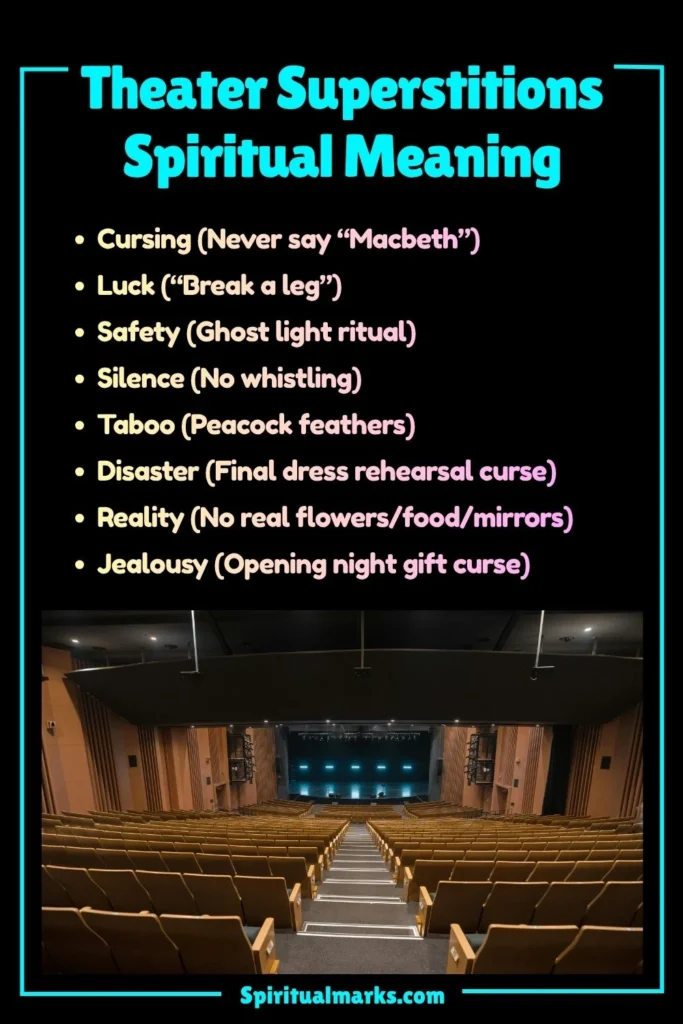
Summary Table: Theater Superstitions and Spiritual Meanings at a Glance
| Superstition | Spiritual Meaning | Cultural Root | Remedy or Practice |
|---|---|---|---|
| Never say “Macbeth” | Words carry power; dark portals | Elizabethan England | Spin, spit, recite Shakespeare |
| Say “Break a Leg” | Deflect the evil eye; inversion blessing | Greek/Roman theater | Use the phrase always |
| Ghost Light | Honor resident spirits; protect sacred space | Global theater tradition | Leave one light burning overnight |
| No Whistling | Avoid summoning trickster forces from above | Sailor/maritime tradition | Never whistle backstage |
| No Peacock Feathers | Evil eye symbol; divine jealousy | Greek, Middle Eastern cultures | Use artificial feathers only |
| Bad Dress Rehearsal = Good Show | Spiritual economy; use up misfortune early | Global theater tradition | Welcome failure in rehearsal |
| No Real Flowers/Mirrors | Death energy; portal risk | Victorian/global esoteric tradition | Use artificial or stage props only |
| No Pre-show Gifts | Avoid premature pride; respect spiritual timing | Jewish, West African traditions | Give gifts after the performance |
| Blue without Silver | Spiritual sensitivity needs grounding | Medieval Europe, alchemical tradition | Pair blue with silver accessories |
| Enter from Stage Right | Align with divine favor; avoid sinister energy | Ancient Roman/Christian tradition | Always approach from the right |
| Never Leave Script Face Down | Respect the sacred text of the production | Cross-cultural reverence for sacred texts | Always place text face up |
| Three Knocks Before Curtain | Seal sacred space; announce to the spirit world | French/European opera tradition | Strike floor three times before show |
A Final Note
Theater superstitions are not relics of a less enlightened age. They are living spiritual technologies, refined by generations of performers who understood something profound: the stage is not an ordinary place, and what happens there is not ordinary work.
When you respect these traditions, whether you believe in them literally or honor them as accumulated theatrical wisdom, you connect yourself to an unbroken chain of human beings who have stood in liminal space and asked for help from forces beyond their control. That is not weakness. That is spiritual intelligence.
The next time you are backstage before a performance, pay attention. The quiet rituals happening around you, the careful words, the particular preparations, the whispered traditions, are prayers in theatrical clothing. They have been working for centuries. They are still working now.
If you work in theater, consider learning the specific protective rituals of your own tradition and honoring them with intention rather than habit. If you are new to performance, start with the basics: say “break a leg,” leave the ghost light burning, and never, under any circumstances, say the name of the Scottish Play.
The stage has a memory far longer than any single production. It honors those who honor it in return.