There is something quietly powerful about December. The air feels different. Days grow shorter, nights stretch longer, and a natural pause begins to settle into life. You might feel reflective without knowing why, drawn toward memories, closure, or even a fresh start. That is not accidental. December carries deep spiritual meaning that goes far beyond holidays or year-end routines.
Across cultures, traditions, and belief systems, the twelfth month represents completion, introspection, and renewal. It marks both an ending and a beginning. While one chapter closes, another quietly prepares to unfold. This dual energy makes December one of the most spiritually charged months of the year.
In this article, we will go beyond surface-level interpretations and examine the deeper symbolism of December. From cultural traditions to astrology, biblical connections, and spiritual symbolism, each layer adds meaning to what this month truly represents.
Key Takeaways
- December symbolizes completion and closure, marking the end of a spiritual cycle before a new beginning.
- It carries strong introspective energy, encouraging reflection, healing, and emotional clarity.
- The month blends darkness and light, representing both inner shadow work and hope.
- Spiritually, it aligns with transformation, where endings quietly prepare the ground for renewal.
- Its significance appears across cultures, religions, and astrology, making it a universally meaningful period.
What Does the Month of December Symbolize?
At its core, December symbolizes completion with purpose. It is not simply the end of a calendar year. It reflects the natural cycle of life itself. Every growth phase needs a pause. Every journey needs a moment of reflection.
Nature mirrors this idea clearly. Trees shed their leaves. Animals retreat. The external world slows down. At the same time, an internal process begins. Roots deepen. Energy gathers. Something unseen prepares for the next season.
Spiritually, December asks you to do the same. It invites you to look inward rather than outward. You may feel drawn to revisit past experiences, rethink decisions, or even release emotional weight that no longer serves you.
At another level, December represents balance between darkness and light. The winter solstice marks the longest night of the year, yet it also signals the gradual return of light. This creates a powerful spiritual message. Even at the darkest point, light has already begun its return.
For many, this month becomes a quiet turning point. Not loud. Not dramatic. But deeply meaningful.
9 Spiritual Meanings of the Month of December
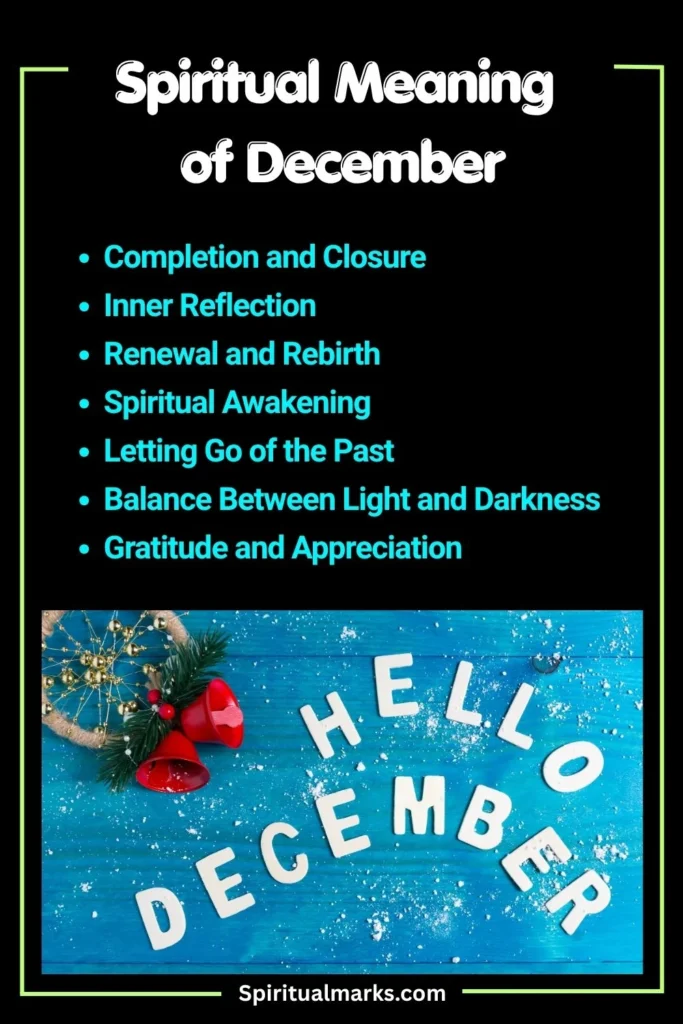
1. Completion and Closure
December carries the unmistakable energy of finishing what was started. You may notice it in subtle ways. Loose ends begin to feel heavier. Unresolved emotions ask for attention. Even small tasks that were ignored throughout the year suddenly feel important.
This is not accidental. Spiritually, December represents a natural point of completion, where life encourages you to gather everything you have experienced and bring it into awareness.
In many traditions, this period mirrors the concept of a harvest. However, instead of collecting crops, you are collecting lessons, growth, and personal insight. Every challenge, success, and mistake becomes part of that harvest. Nothing is wasted.
At the same time, closure is rarely neat. Some chapters end with clarity, while others remain unfinished. Spiritual teachings often highlight that true closure does not always come from external resolution. It comes from internal acceptance. You begin to recognize what you can carry forward and what must stay behind.
For you, this may feel like a quiet evaluation. What did this year ask of you? What did it give in return? And more importantly, what are you ready to release?
Completion, in this sense, is not about perfection. It is about acknowledgment.
2. Inner Reflection
As December unfolds, the external world often slows down, especially in regions where winter dominates. Days shorten. Nights stretch longer. Activity decreases. This natural shift creates space for something deeper.
You begin to turn inward.
Inner reflection becomes more accessible during this time because distractions lose their intensity. The quieter environment supports a kind of mental and emotional stillness that is harder to reach during busier seasons.
Many spiritual traditions view this inward turn as essential. Reflection is not passive thinking. It is an active process of examining beliefs, patterns, and motivations. You start asking questions that do not always have immediate answers.
Why did certain experiences affect you so deeply?
What patterns repeated themselves throughout the year?
Where did you grow, even if it did not feel obvious at the time?
This period often reveals contrasts. You may feel proud in some areas and uncertain in others. That contrast is not a flaw. It is part of reflection’s purpose. It shows you the full picture.
When you engage with this process honestly, reflection becomes a tool for clarity and alignment rather than self-criticism.
3. Renewal and Rebirth
At first glance, December seems like an ending. Yet beneath that surface, a quieter movement begins. Renewal.
This meaning is closely tied to the winter solstice, a moment when darkness reaches its peak before slowly giving way to increasing light. Symbolically, this shift carries powerful implications. It suggests that even at the lowest point, change has already begun.
In older European traditions, this period marked the rebirth of the sun. Light did not disappear. It transformed, paused, and then returned with new strength. That same pattern appears in personal growth.
Renewal does not always look dramatic. It often starts in stillness. You may not feel different immediately. Yet something within you begins to reset and reorganize.
This is why many people feel a subtle sense of anticipation in December. Even without clear reasons, there is a quiet awareness that something new is forming.
Rebirth, in this context, is not about becoming someone entirely different. It is about returning to a more authentic version of yourself, shaped by everything you have experienced.
4. Spiritual Awakening
December holds a unique relationship with light. Despite being one of the darkest periods of the year in certain regions, it is also filled with symbols of illumination. Candles, festive lights, and sacred rituals all point toward the same idea.
Light persists.
Spiritually, this contrast between darkness and light often represents awakening. You begin to see things more clearly, not because external conditions improve, but because your awareness deepens.
Some traditions associate specific dates in December with heightened spiritual energy, interpreting them as moments when consciousness becomes more accessible. Whether taken literally or symbolically, the underlying message remains consistent.
Awakening involves recognition. You start noticing patterns you once ignored. You understand emotions with greater depth. Similarly, you become aware of connections between your inner world and your external experiences.
This process can feel both enlightening and unsettling. Clarity often brings discomfort before it brings peace. Yet that discomfort plays a role. It pushes you toward growth.
In this sense, December becomes a period where awareness expands, even if quietly.
5. Letting Go of the Past
Closure naturally leads to release. December invites you to examine what you are still holding onto and question whether it continues to serve you.
Letting go is often misunderstood. It does not mean forgetting or dismissing what happened. Instead, it involves loosening the emotional grip that certain experiences maintain over you.
This can include regret, resentment, guilt, or even outdated identities. You may realize that some aspects of your past continue to influence your present more than they should.
Many spiritual practices associated with December focus on symbolic release. Writing, reflection, or simple acts of acknowledgment allow you to process and release emotional weight.
This process can feel challenging because attachment often provides a sense of familiarity. Even negative patterns can feel comfortable when they are known. Letting go requires stepping into uncertainty.
Yet release creates space. Without it, renewal struggles to take root.
December, therefore, becomes a time where you are gently encouraged to ask a difficult but necessary question. What are you ready to leave behind?
6. Balance Between Light and Darkness
The winter solstice represents a turning point, but it also symbolizes balance. Darkness reaches its peak, yet light begins its return. Neither dominates completely. Both exist together.
Spiritually, this reflects a deeper truth about human experience. Life is not divided into simple categories of good and bad. Instead, it operates within a dynamic balance of opposing forces.
December highlights this balance in a tangible way. You may feel moments of joy alongside moments of heaviness. Celebration may coexist with introspection. Energy may fluctuate between outward connection and inward solitude.
Rather than viewing these contrasts as contradictions, many traditions encourage acceptance. Darkness is not treated as something to eliminate. It is seen as a space for rest, integration, and transformation.
When you recognize this balance, you begin to approach your own experiences differently. Difficult emotions no longer feel like interruptions. They become part of a larger rhythm.
This perspective creates a more grounded and realistic understanding of growth.
7. Gratitude and Appreciation
As the year comes to a close, attention often shifts toward what remains rather than what is missing. This shift naturally gives rise to gratitude.
December, with its gatherings and shared moments, encourages you to reflect on the people, experiences, and unseen influences that shaped your journey. Gratitude in this context is not limited to positive outcomes. It also includes recognition of challenges that led to growth.
Different traditions express this in various ways. Some focus on thanksgiving and spiritual acknowledgment. Others emphasize communal connection and shared reflection.
At its core, gratitude changes perspective. It moves focus away from scarcity and toward recognition of value.
You may begin to notice small details that previously went overlooked. Support from others. Personal resilience. Moments of quiet progress.
This shift does not ignore difficulties. Instead, it places them within a broader context, allowing appreciation to coexist with complexity.
8. Preparation for New Beginnings
While December centers on endings, it simultaneously prepares the ground for what comes next. This dual role creates a sense of transition that is both reflective and forward-looking.
Preparation during this time is not always about setting concrete plans. It often begins with internal alignment. You start clarifying what matters to you, what direction feels meaningful, and what changes feel necessary.
In numerology, the number twelve often represents completion followed by renewal. December, as the twelfth month, reflects this cycle. It closes one phase while opening the door to another.
This transitional energy can feel subtle. You may not have all the answers yet. That is part of the process. Preparation involves creating space and intention, rather than forcing immediate clarity.
As you move through December, you may notice a gradual shift from reflection to anticipation. That shift signals readiness, even if it feels incomplete.
9. Emotional Healing
December often brings emotions to the surface. Memories resurface. Relationships come into focus. Expectations, both fulfilled and unmet, become more visible.
This emotional intensity is not accidental. The reflective nature of the month creates conditions where unresolved feelings can no longer remain hidden.
Healing, in this context, begins with acknowledgment. You allow yourself to recognize what you feel without immediate judgment or avoidance.
For some, this may involve confronting grief or loss. For others, it may involve recognizing patterns in relationships or personal behavior. Each experience is different, yet the underlying process remains similar.
You begin to process, rather than suppress.
Many spiritual perspectives emphasize that healing does not require perfection. It requires presence. When you stay present with your emotions, even briefly, you create opportunities for release and integration.
December provides a natural environment for this work. Its slower pace and reflective tone support deeper emotional awareness.
Cultural and Religious Significance of December
December holds a unique place across many cultures and religions. While traditions differ, a shared theme runs through them all: light emerging from darkness.
In Christianity, December centers around the celebration of Christmas. This marks the birth of Jesus Christ, symbolizing hope, salvation, and divine presence entering the human world. The timing aligns with the darkest period of the year, reinforcing the idea that light arrives when it is needed most.
In ancient Roman culture, Saturnalia took place in December. This festival honored Saturn, the god of agriculture. It included feasting, gift-giving, and a temporary reversal of social roles. Beneath the celebration, it carried a deeper meaning about renewal and the cyclical nature of life.
Pagan traditions observe the winter solstice, often called Yule. This event marks the rebirth of the sun. Rituals focus on light, warmth, and the promise of longer days ahead. Many modern holiday customs trace back to these ancient practices.
In Hindu traditions, while December does not always align with a major festival every year, it often overlaps with periods of spiritual discipline and reflection, especially during certain lunar phases. These moments emphasize inner purification and devotion.
In East Asian cultures, the winter solstice festival highlights family unity and balance. People gather, share meals, and honor the harmony between yin and yang energies.
What Are the Astrological Significance of December?
December is influenced by two zodiac signs: Sagittarius and Capricorn. Each brings a distinct energy that shapes the spiritual tone of the month.
Sagittarius dominates the early part of December. This fire sign is known for curiosity, expansion, and philosophical thinking. During this period, you may feel a strong urge to seek meaning, ask deeper questions, or look beyond everyday routines. It encourages growth through exploration, both mentally and spiritually.
As the month progresses, Capricorn takes over. This earth sign introduces discipline, structure, and responsibility. It grounds the expansive energy of Sagittarius and redirects it toward practical goals. Capricorn energy asks you to take what you have learned and apply it with focus and commitment.
For some zodiac signs, December feels supportive and empowering. Fire signs like Aries and Leo often thrive during Sagittarius season, finding motivation and clarity. Earth signs such as Taurus and Virgo resonate with Capricorn’s grounded approach, making it easier to plan and build.
However, water signs like Cancer and Pisces may feel emotionally sensitive during this period. The reflective nature of December can intensify feelings, requiring patience and self-awareness. Air signs such as Gemini and Libra might experience restlessness, especially when Capricorn energy demands structure.
People born in December often display a blend of traits. They can be optimistic yet practical, adventurous yet disciplined. Many show strong leadership qualities, a sense of purpose, and a deep desire to grow, both personally and spiritually.
Biblical Meaning of the Month of December or 12th Month
While the modern calendar does not directly align with biblical months, December still carries symbolic meaning within a biblical context.
The number twelve holds strong significance in the Bible. It represents divine order, completeness, and authority. There are twelve tribes of Israel and twelve apostles, both symbolizing structured spiritual systems guided by divine intention.
A relevant verse appears in Ecclesiastes 3:1 (KJV):
“To every thing there is a season, and a time to every purpose under the heaven.”
This verse reflects the essence of December. It reminds us that endings are not random. They serve a purpose within a larger spiritual design.
Another meaningful verse is Isaiah 9:2 (KJV):
“The people that walked in darkness have seen a great light.”
This connects directly with the spiritual symbolism of December as a time when light emerges from darkness.
December also aligns with themes of preparation and expectation. In Christian belief, the period leading up to Christmas, often called Advent, focuses on waiting, reflection, and spiritual readiness.
Significance of December in Hebrew
In the Hebrew calendar, December often overlaps with the months of Kislev and Tevet. Each carries its own spiritual depth.
Kislev connects with faith and trust. It includes Hanukkah, the Festival of Lights, which celebrates perseverance and divine miracles. The story behind Hanukkah emphasizes hope during challenging times, reinforcing the idea that even a small light can overcome darkness.
Tevet, on the other hand, carries a more introspective tone. It is associated with fasting, reflection, and spiritual discipline. This aligns closely with the inner-focused energy many people feel during December.
Together, these months highlight a balance between celebration and introspection. Light and stillness exist side by side, creating a complete spiritual experience.
Spiritual Symbolism of December Gemstone, Color, and Flower
December’s symbolic elements add another layer of meaning.
The primary gemstones linked to December include turquoise, tanzanite, and zircon. Turquoise, in particular, represents protection, healing, and spiritual grounding. It has been used for centuries as a stone of wisdom and emotional balance.
The color most associated with December is deep blue. This color reflects calmness, introspection, and truth. It encourages clarity of thought and emotional depth. In many traditions, blue also symbolizes divine connection and inner peace.
December’s flower is the narcissus, often associated with hope, renewal, and self-reflection. Its presence during the colder months serves as a quiet reminder that life continues even in stillness.
These symbols work together to reinforce December’s deeper message. Protection, reflection, and quiet growth all play a role.
Table: Spiritual Meaning of December
| Aspect | Spiritual Meaning |
|---|---|
| Month Number | Completion, divine order |
| Season | Reflection, rest, preparation |
| Elemental Energy | Balance of fire and earth |
| Light Symbolism | Hope emerging from darkness |
| Emotional Theme | Healing and closure |
| Spiritual Focus | Inner growth and renewal |
| Gemstone | Protection and grounding |
| Color | Calmness and clarity |
| Flower | Renewal and self-awareness |
A Final Note
December is not only about endings. It is about integration, awareness, and quiet transformation. Each of its spiritual meanings connects to a larger cycle that continues beyond the calendar.
Completion teaches you to acknowledge your journey. Reflection deepens your awareness. Renewal reminds you that change is always possible. Letting go creates space. Balance brings perspective. Gratitude shifts your focus. Preparation aligns your direction. Healing restores your inner stability.
Together, these themes form a powerful closing chapter.
As you move forward, you might choose to pause and ask yourself a few grounded questions. What am I carrying that still matters? What feels ready to be released? And, what kind of energy do I want to step into next?
The answers do not need to be immediate or perfect. What matters is your willingness to engage with them.
December, in its quiet intensity, offers that opportunity.
References
- https://www.spiritualmarker.com/december-spiritual-meaning-symbolism-significance/
- https://spiritualyou.org/spiritual-meaning-and-symbolism-of-december/
- https://spiritualmeanings.net/december-symbolism-and-spiritual-meaning/
- https://wisdomofthespirit.com/the-spiritual-meaning-of-december/
- https://www.facebook.com/groups/collectivespirituality/posts/4169337749989001/
- https://consciousreminder.com/2024/12/02/the-deeper-meaning-of-december-beginning-the-end/
- https://meaning-of.net/spiritual/spiritual-meaning-of-december/
- https://steemit.com/christiantrail/@kingsleymond/covenant-significance-of-the-twelfth-month-december