Kintsugi Spiritual Meaning: The Sacred Art of Healing Through Brokenness
You have been broken before. Maybe it was a relationship that shattered without warning. Maybe it was grief, failure, illness, or loss. You tried to hide the cracks, smooth them over, pretend nothing happened. But what if those very cracks were your greatest spiritual asset?
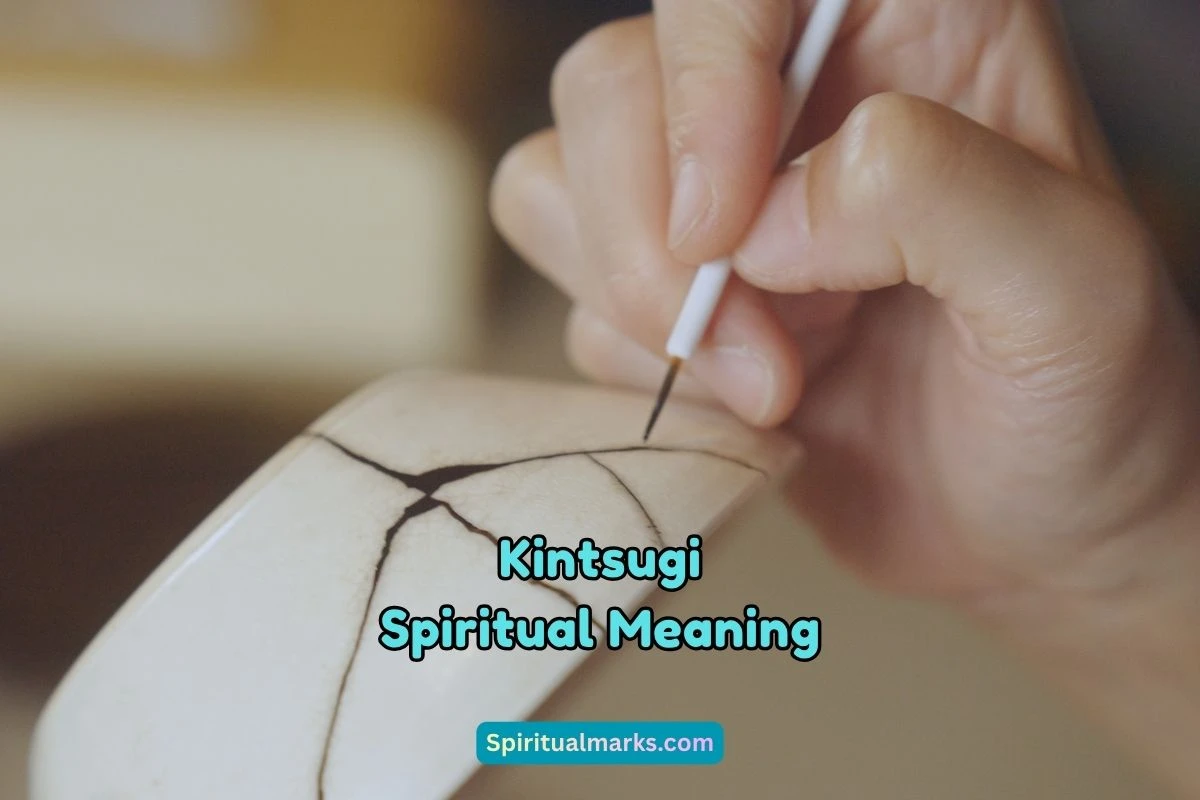
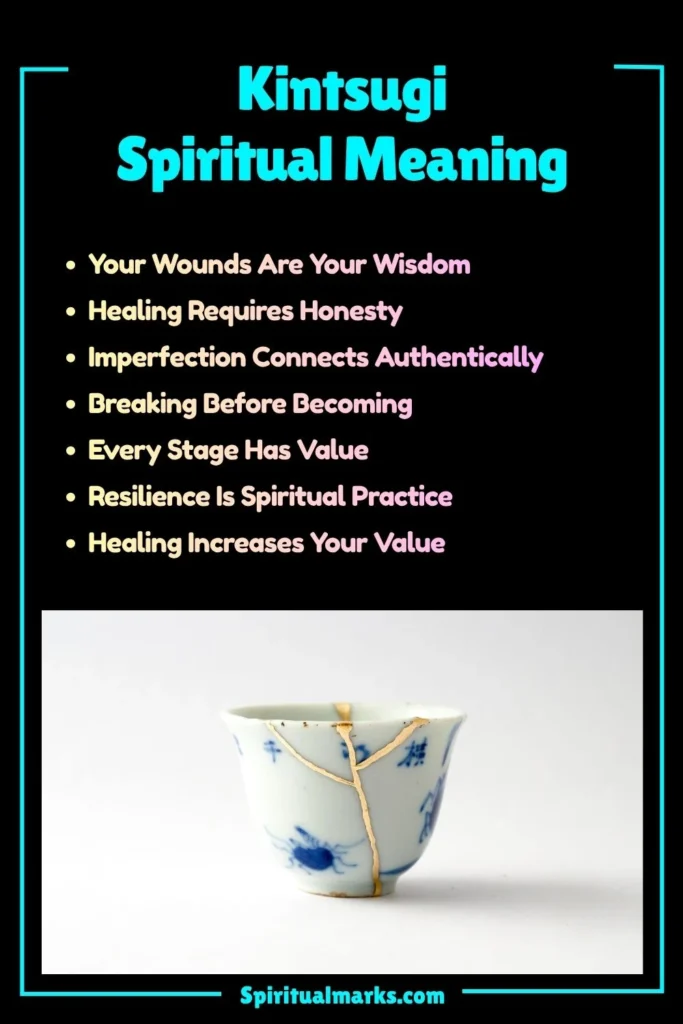
Kintsugi is a centuries-old Japanese art form that answers this question in the most stunning way possible. The word itself combines two Japanese terms: kin, meaning gold, and tsugi, meaning joinery or repair. Instead of discarding a broken ceramic vessel, kintsugi artists mend the fractures with lacquer mixed with powdered gold, silver, or platinum. The result is a piece more visually striking than the original.
But kintsugi is far more than a craft. It is a spiritual philosophy, a healing practice, and a radical reframing of what it means to be whole. The kintsugi spiritual meaning reaches into the core of human experience. It whispers that your wounds do not diminish you. They define you in the most sacred way possible.
This blog post walks you through every dimension of kintsugi’s spiritual significance. From its roots in Japanese Buddhist philosophy to its echoes in world religions, from dream symbolism to practical healing wisdom, you will find here a complete and deeply personal guide to one of the most powerful spiritual metaphors ever created.
Key Takeaways
- Kintsugi teaches that brokenness is sacred, not shameful. Your fractures are part of your spiritual story.
- The philosophy is rooted in wabi-sabi, the Japanese worldview that finds beauty in imperfection and impermanence.
- Every major world religion carries a version of kintsugi’s spiritual message, from Christian redemption to Buddhist non-attachment.
- Dreaming of kintsugi or broken pottery repaired with gold often signals personal transformation, resilience, and spiritual awakening.
- Kintsugi as a healing practice is now used in psychology and therapy to help people process trauma and rebuild identity with self-compassion.
What Is Kintsugi and Why Does It Carry Such Deep Spiritual Power?
Kintsugi emerged in 15th-century Japan, reportedly when the Shogun Ashikaga Yoshimasa sent a broken Chinese tea bowl back to China for repairs. The metal staples used to fix it were considered ugly. Japanese craftsmen developed kintsugi as a far more beautiful solution. Over time, what began as a repair technique became a profound spiritual statement.
The power of kintsugi lies in what it refuses to do. It refuses to hide damage. It refuses to pretend a wound never happened. Instead, it highlights the break, pours gold into it, and presents the healed object to the world with pride. This act is inherently spiritual because it mirrors the deepest kind of human healing.
Spiritual traditions across the world recognize that suffering is not an obstacle to a meaningful life. It is often the very path toward one. Kintsugi makes this truth visible and tangible. When you hold a kintsugi bowl, you hold proof that something can be broken, healed, and made more beautiful than before. That experience resonates at a soul level.
The spiritual power of kintsugi also comes from its relationship to mindfulness and presence. The repair process is painstaking, slow, and intentional. It demands full attention. This mirrors the spiritual work of healing, which also demands patience, awareness, and the willingness to sit with discomfort before beauty emerges.
The Philosophy Behind Kintsugi: Wabi-Sabi and Buddhist Roots
To understand the kintsugi spiritual meaning fully, you must understand wabi-sabi. This is the Japanese aesthetic philosophy that sees beauty in imperfection, transience, and incompleteness. Wabi-sabi does not celebrate flaws ironically or reluctantly. It views imperfection as the very essence of authentic beauty.
Wabi-sabi is deeply rooted in Zen Buddhism. Zen teaches that clinging to permanence causes suffering. Nothing lasts. Everything changes. The cracked bowl, the wilting flower, the weathered face are all expressions of the natural order. Resisting this order creates pain. Accepting it creates peace.
Kintsugi is a living expression of wabi-sabi. When the craftsman fills a crack with gold, he does not pretend the break never happened. He honors the history of the object. He acknowledges that this bowl has lived, has suffered, and has survived. That history becomes its most valuable quality.
Buddhist teachings on impermanence, called anicca, align perfectly with kintsugi. The Buddha taught that all conditioned things are transient. Suffering arises when we resist this truth. Kintsugi offers a practical, visual meditation on impermanence. It teaches you to hold things loosely, to love deeply without clinging, and to find meaning in every stage of existence, including the broken ones.
The concept of mushin, or “no mind,” also connects here. Mushin refers to a state of mental clarity free from ego, fear, and attachment. The kintsugi artist works in mushin, allowing the repair to emerge naturally without forcing a predetermined outcome. Spiritually, this mirrors the healing journey. You cannot control exactly how you will reassemble. You can only remain present and trust the process.
7 Spiritual Meanings of Kintsugi
1. Your Wounds Are Not Your Weakness, They Are Your Wisdom
The most fundamental kintsugi spiritual meaning is this: your scars are sacred. In most cultures, damage is equated with diminished value. A cracked vase is worth less. A person with trauma is seen as fragile. Kintsugi completely overturns this logic.
The gold that fills the crack is not a patch. It is a proclamation. It says, “This piece has a history. This piece has survived.” In the same way, your emotional wounds carry wisdom that untouched, unbroken people do not possess. A person who has grieved deeply understands compassion in a way others cannot. A person who has failed understands resilience firsthand.
Many spiritual traditions speak directly to this truth. The Christian concept of redemption holds that suffering, when surrendered, becomes the soil of spiritual growth. The wounds of Christ are not hidden in Christian theology. They are displayed as the most powerful symbols of divine love. Kintsugi mirrors this beautifully.
Your pain, in other words, is not a chapter to skip. It is the chapter that changes everything. Kintsugi asks you to stop apologizing for your history and start honoring it as the source of your deepest strength and most genuine wisdom.
2. Healing Requires Honesty, Not Concealment
Kintsugi does not use opaque paint. It does not match the original glaze to make the repair invisible. It uses gold, the most conspicuous material possible. This is a radical spiritual statement about the nature of healing. True healing requires honesty.
Many people attempt what could be called spiritual concealment. They bury grief with productivity. They mask insecurity with performance. They cover old pain with new distractions. This approach does not heal. It preserves the wound in a state of suspended damage, much like a poorly repaired bowl that hides its cracks under paint but remains structurally weak.
True spiritual healing, as kintsugi illustrates, begins with visibility. You must first acknowledge the break. You must name the pain, sit with the fracture, and resist the urge to rush toward normalcy. This is what contemplative traditions across the world call the “dark night of the soul,” the honest descent before the luminous ascent.
When you bring your brokenness into the light and work with it rather than against it, something unexpected happens. The very act of honest acknowledgment begins the healing. The gold of kintsugi represents the grace, self-compassion, and spiritual truth that can only enter through honesty. You cannot fill a crack you are pretending does not exist.
3. Imperfection Is a Gateway to Authentic Connection
One of the most overlooked dimensions of the kintsugi spiritual meaning is its teaching on authentic human connection. A perfectly glazed, unmarked bowl is beautiful. But it tells no story. A kintsugi bowl, veined with gold, immediately invites curiosity. It starts a conversation. It connects people.
Spiritual community is built not on shared perfection but on shared vulnerability. The people who have moved you most deeply are rarely those who appeared flawless. They are the ones who said, “I have been there too.” They are the ones who showed you their scars and made yours feel less shameful.
Research in psychology and social science confirms this. Dr. Brené Brown’s extensive work on vulnerability demonstrates that authentic connection requires the courage to be seen in your imperfection. People who suppress or hide their struggles report higher rates of disconnection, anxiety, and spiritual emptiness.
Kintsugi, as a spiritual metaphor, gives you permission to stop performing wholeness. Your visible cracks create bridges of empathy. When you share your healing story honestly, you give others permission to begin their own. The gold in your fractures is not just your healing. It is a beacon for others who are still searching for the courage to begin.
4. Transformation Requires Breaking Before Becoming
Many spiritual traditions teach that profound transformation cannot occur without a period of dissolution. Seeds must crack open before they become plants. Caterpillars fully dissolve inside the chrysalis before becoming butterflies. The breaking is not a detour from the journey. It is the journey itself.
Kintsugi embodies this truth in ceramic form. The bowl must break before it can become a kintsugi masterpiece. No break means no golden repair. No golden repair means no transformation. The original, unbroken bowl, however beautiful, cannot achieve what the kintsugi bowl achieves without first experiencing fracture.
In Sufi mysticism, this concept appears in the teaching of the broken heart as the most open heart. The Sufi poet Rumi wrote extensively about how the wound is where the light enters. Kintsugi visualizes this precisely. The crack is the channel. The fracture is the opening through which something far greater pours in.
This meaning should deeply comfort you if you are currently in a season of breaking. You are not failing. You are not falling apart. You are undergoing the sacred dissolution that precedes your most powerful becoming. The gold is coming. But it can only arrive through the crack that currently frightens you.
5. Every Stage of Life Holds Spiritual Value
Kintsugi teaches a radical form of temporal equality. The original bowl has value. The broken bowl has value. The repaired bowl has value. No stage is superior. No phase is wasted. Each iteration of the bowl’s existence contributes to its ultimate beauty and meaning.
This is a deeply countercultural spiritual message. Western culture, in particular, often treats life as a linear progression toward a peak. Youth is celebrated. Aging is mourned. Success is cherished. Failure is hidden. There is little cultural space for the beauty of the in-between, the incomplete, the still-healing.
Hindu philosophy offers a complementary perspective through the concept of dharma at every life stage. The four ashramas, or life stages, each carry specific spiritual value. No stage is merely a prelude to the next. Each is complete in itself. Kintsugi echoes this wisdom by refusing to designate any phase of the bowl’s history as lesser.
For you, this means that your current season has spiritual significance, regardless of how unfinished it feels. The period of active grief is not a waiting room before real life resumes. The season of uncertainty is not a gap between meaningful chapters. You are always in the middle of something sacred. Kintsugi shows you that the repair itself, not just the finished product, carries profound beauty.
6. Resilience Is a Spiritual Practice, Not Just a Personal Trait
Most people think of resilience as a psychological characteristic. Some people have it; others do not. But kintsugi reframes resilience as a spiritual practice, something cultivated deliberately through intentional choices about how you relate to your own suffering.
The kintsugi artist does not simply wait for the bowl to repair itself. The repair demands active, skilled, patient engagement. The artist selects the gold carefully. The lacquer is applied with precision. The process takes time. This mirrors what genuine spiritual resilience actually looks like. It is not passive endurance. It is active participation in your own healing.
Stoic philosophy, which shares surprising overlap with kintsugi wisdom, teaches that you cannot control what happens to you. You can only control your response. The Stoic practice of amor fati, or love of fate, invites you to not merely accept your suffering but to embrace it as the necessary raw material of your character. Kintsugi takes this further by suggesting that you can actively beautify the very experience of overcoming.
Practicing kintsugi spiritually means choosing, day after day, to pour something meaningful into your fractures. It means choosing therapy, prayer, meditation, honest conversation, creative expression, or service to others. It means treating your healing not as something that happens to you but as something you co-create with intention, courage, and golden care.
7. You Are More Valuable After Healing Than Before Breaking
This final and perhaps most powerful kintsugi spiritual meaning is the one that most directly challenges cultural conditioning. The repaired kintsugi bowl is worth more, not less, than the original. Collectors and spiritual practitioners across the world prize kintsugi pieces precisely because of their visible repairs. The brokenness adds value.
This truth runs counter to almost every message you have received about damage, failure, and imperfection. Society rewards the pristine, the unbroken, the effortlessly successful. It treats the damaged, the struggling, the healing as somehow lesser. Kintsugi declares this assessment completely wrong.
In spiritual terms, the healed soul carries a luminosity that the untested soul cannot. The person who has descended into grief and climbed back out carries a depth of compassion, a quality of presence, and a capacity for joy that is richer and more textured than before. This is the gold. It was not there originally. It arrived precisely because of the breaking.
Many wisdom traditions recognize this. Islamic spirituality speaks of the concept of sabr, patient perseverance through hardship, as one of the highest spiritual virtues. The Quran repeatedly promises that those who endure with patience will receive something far greater than what they lost. Kintsugi makes this promise visible. Your suffering, when met with grace and patience, produces something more magnificent than what existed before. You are not a diminished version of your former self. You are a golden-veined masterpiece in the making.
Kintsugi Meaning Across World Religions and Spiritual Traditions
The spiritual meaning of kintsugi resonates across virtually every major religious and spiritual tradition. This universality is itself significant. It suggests that the wisdom encoded in kintsugi touches something fundamental to the human spiritual experience.
Christianity
Christian theology is built around the narrative of brokenness transformed by grace. The crucifixion, which appears to be the ultimate devastation, becomes the source of the greatest redemption. The wounds of Christ are not erased in resurrection accounts. They remain visible and become the very evidence of divine love.
The Apostle Paul writes in 2 Corinthians 12:9, “My grace is sufficient for you, for my power is made perfect in weakness.” This is theological kintsugi. The weakness is not removed. Grace pours into it and makes it the site of divine power. For Christian believers, personal suffering is not evidence of divine abandonment. It is often the very place where divine presence becomes most palpable and personal.
Buddhism
Buddhist philosophy provides kintsugi’s most direct philosophical foundation. The Four Noble Truths acknowledge that suffering is an inherent part of existence. The Eightfold Path offers a way of relating to suffering skillfully. Kintsugi is a physical expression of the Buddhist middle path, neither denying pain nor being destroyed by it.
Zen Buddhism in particular prizes the broken and imperfect object. The renowned tea master Sen no Rikyu, who lived in 16th-century Japan, elevated the cracked and irregular tea bowl to the highest aesthetic status. He understood that the marks of time and use gave an object sabi, the beauty of age and impermanence. This sensibility gave rise to the conditions in which kintsugi could flourish as both art and spirituality.
Hinduism
Hindu spirituality approaches suffering through multiple philosophical lenses, all of which resonate with kintsugi’s wisdom. The concept of Shiva as the destroyer is not about annihilation for its own sake. Shiva destroys what is worn out, corrupt, or limiting so that new life can emerge. The break is Shiva’s work. The golden repair is Brahma’s creation. The whole cycle is Vishnu’s preservation.
The Bhagavad Gita teaches that the eternal self, the atman, is never truly broken. What breaks are the temporary forms the self inhabits. This perspective allows the Hindu practitioner to witness personal suffering with a kind of sacred detachment, understanding that the fractures occur at the level of form, not at the level of the indestructible soul within.
Sufism and Islam
Sufi mystics have long celebrated the broken heart as spiritually superior to the untouched one. Rumi, the 13th-century Persian poet and Sufi master, wrote extensively about how the reed flute, cut from the reed bed and therefore fundamentally broken and separated, produces the most beautiful and yearning music precisely because of that wound.
The Quranic concept of sabr and the hadith literature’s celebration of the believer who endures hardship both echo the kintsugi message. In one famous hadith, the Prophet Muhammad said that no fatigue, illness, anxiety, sorrow, harm, or sadness afflicts a believer, even a thorn that pricks them, except that God expiates some of their sins through it. Suffering, in this framework, is not meaningless. It is spiritually alchemical, transforming sin and limitation into spiritual gold.
Indigenous and Shamanic Traditions
Many indigenous spiritual traditions around the world speak of the healer who was first broken. The wounded healer archetype, identified by psychiatrist Carl Jung and present in shamanic traditions globally, holds that the healer’s power comes directly from their experience of wounding and survival. The shaman descends into illness, crisis, or spiritual dismemberment and returns with healing gifts for the community.
This is kintsugi wisdom in its oldest form. The crack is what allows the medicine to flow. The person who has not suffered cannot truly heal others. The community’s most powerful healers are often those whose gold lines are most visible.
Kintsugi in World Mythologies and Ancient Stories
Mythology has always understood the spiritual power of the broken and repaired. Long before kintsugi emerged as a named practice, ancient storytelling traditions were encoding its wisdom.
The myth of Osiris from ancient Egypt presents one of the most striking kintsugi narratives in world mythology. Osiris is dismembered by his brother Set, his body scattered across Egypt. His wife Isis collects the fragments and reassembles him. Osiris is not restored to exactly what he was before. He becomes something more powerful: the god of the afterlife and resurrection. His breaking is what makes his transcendence possible.
The Greek myth of Psyche follows a similar arc. Psyche undergoes a series of devastating trials, including a descent into the Underworld, before she can be united with Eros and achieve immortality. Each trial breaks something in her. Each breaking produces a quality she did not previously possess. By the end of her journey, she has been forged by fracture into something divine.
Norse mythology offers the story of the god Tyr, who sacrifices his hand to bind the great wolf Fenrir. Tyr’s missing hand becomes his most defining characteristic. It represents his courage, his willingness to sacrifice for the community, and his unique authority as a god of justice. His wound is his credential, not his disqualification.
In Japanese mythology itself, the Shinto concept of musubi, the generative spiritual force that binds all things, operates through a process of separation and reunion. Things must come apart before they can be reassembled in a more powerful configuration. Kintsugi enacts this mythological pattern in miniature on the potter’s workbench.
Kintsugi and the Psychology of Healing: Where Spirituality Meets Science
The spiritual meaning of kintsugi has not gone unnoticed by modern psychologists and therapists. In recent decades, kintsugi has become a significant framework in trauma-informed care and positive psychology.
Post-traumatic growth, a concept developed by psychologists Richard Tedeschi and Lawrence Calhoun, describes the psychological and spiritual growth that many people experience after significant adversity. Research indicates that between 30 and 70 percent of trauma survivors report meaningful positive changes in their life perspective, relationships, and sense of personal strength following their experience. This is psychological kintsugi, the golden lines appearing in the aftermath of fracture.
Therapists working in the tradition of narrative therapy use kintsugi explicitly as a healing metaphor. Rather than working to return clients to a “pre-trauma baseline,” they help clients construct a new identity narrative in which the trauma is a golden vein, not a hidden flaw. The goal is not to become who you were before. The goal is to become someone richer, deeper, and more authentically yourself because of what you have survived.
Mindfulness-based therapies also align with kintsugi’s spiritual wisdom. The core mindfulness teaching of non-judgmental awareness of present experience, including painful experience, mirrors the kintsugi approach of looking at the break clearly and honestly before beginning the repair. You cannot heal what you will not see.
Japanese therapist and author Tomás Navarro wrote a book titled Kintsugi: The Japanese Art of Embracing Your Imperfections and Finding Happiness that brought kintsugi psychology to a global audience. His clinical work demonstrated that helping patients view their psychological wounds through the kintsugi lens reduced shame, increased resilience, and accelerated healing in measurable ways.
Dreaming of Kintsugi: Spiritual and Psychological Meanings
Dreams involving broken and repaired objects, particularly ceramics or bowls repaired with gold, carry rich spiritual significance. Dream interpretation across multiple traditions suggests that these images often arise at pivotal moments of personal transformation.
If you dream of a broken bowl or vessel, your subconscious may be processing feelings of fragmentation, identity disruption, or emotional rupture. The vessel in dream symbolism often represents the self, the container of your inner life. A break in the vessel signals a break in your sense of wholeness or continuity.
If the broken vessel in your dream is being repaired with gold or light, this is widely interpreted as a profoundly positive spiritual sign. It suggests that the healing process is actively underway, even if you cannot consciously perceive it. Your deeper self is already working to integrate the fracture. Gold in dreams across virtually all traditions represents divine energy, spiritual value, and transformation at the highest level.
Jungian dream analysis would interpret kintsugi imagery as the work of the Self archetype, the organizing principle of the psyche that seeks wholeness. When the Self appears in dreams as a repair process, it signals a period of deep integration. Disparate parts of the psyche are being gathered and unified into a more coherent, luminous whole.
If you dream of holding a kintsugi object and feeling awe, reverence, or deep peace, this often signals spiritual readiness. You are approaching the point where you can genuinely honor your own history of breaking and healing. This is a significant milestone in spiritual maturity.
Dreaming of teaching others the kintsugi technique suggests a calling toward healing ministry, mentorship, or service. Your own healed wounds are becoming resources for others. The gold in you is ready to illuminate the path for someone else.
How to Apply Kintsugi Spiritual Meaning to Your Own Life
The kintsugi philosophy is not meant to remain abstract. It is a living practice, applicable to the specific textures of your everyday existence.
Start by identifying your cracks. This is not about rumination or reopening wounds needlessly. It is about honest inventory. Where have you been broken? What losses, failures, or betrayals have left marks? Name them. Write them down if that helps. Visibility is the first step in the kintsugi repair process.
Choose your gold deliberately. In the physical practice of kintsugi, the gold is applied with great intentionality. In your spiritual life, the gold represents the healing resources you choose to invest in your fractures. This might be therapy, spiritual direction, honest conversation with trusted friends, prayer, meditation, creative expression, or service to others who are suffering. Each of these is gold. Pour them into your cracks with the same care a kintsugi artist brings to the bowl.
Practice radical self-compassion. The kintsugi artist does not berate the bowl for breaking. Applying this to yourself means releasing self-judgment about your wounds, mistakes, and limitations. Self-compassion is not self-indulgence. Research by Dr. Kristin Neff at the University of Texas demonstrates that self-compassion is consistently associated with greater resilience, lower anxiety, and more sustainable motivation than self-criticism.
Share your golden lines. The kintsugi bowl is not locked away in a cabinet. It is used, displayed, and shared. Your healed wounds carry a similar gift. When you share your healing story authentically with others who are suffering, you pour gold into their cracks too. Community healing operates through this exchange of visible, honored wounds.
Summary Table: Kintsugi Spiritual Meaning at a Glance
| Aspect | Kintsugi Spiritual Meaning |
|---|---|
| Core Philosophy | Brokenness is sacred; wounds become wisdom |
| Japanese Roots | Wabi-sabi and Zen Buddhist teachings on impermanence |
| Primary Symbol | Gold-filled cracks representing healing, grace, and transformation |
| Christian Connection | Redemption through suffering; power made perfect in weakness |
| Buddhist Connection | Impermanence (anicca), non-attachment, and mindful healing |
| Sufi Connection | The broken heart as the most open heart; sabr as spiritual gold |
| Hindu Connection | Shiva’s creative destruction; the eternal atman beyond fracture |
| Mythological Echo | Osiris, Psyche, Tyr: breaking as the prerequisite to transcendence |
| Psychological Parallel | Post-traumatic growth; narrative therapy; mindfulness-based healing |
| Dream Symbolism | Repair with gold signals active spiritual transformation and integration |
| Key Spiritual Lesson | You are worth more after healing, not less |
| Practical Application | Name your cracks, choose your gold, practice self-compassion, share your story |
A Final Note
Kintsugi is a mirror. Hold it up to your own life and you will see something extraordinary. You will see a history of breaking and surviving. You will see cracks that were once devastating and are now filled with something luminous. You will see yourself, not as a damaged version of who you used to be, but as a work of sacred art in progress.
The kintsugi spiritual meaning does not promise that breaking will not hurt. It promises something far more honest and far more powerful: that the hurt is not wasted. That the fracture has a purpose. That something golden is already moving toward your open cracks.
You do not need to be fully healed to begin. You do not need to have your story completely figured out. The kintsugi artist does not wait for the perfect moment. The artist simply begins, carefully and with reverence, to pour gold into what is broken.
If you are in a season of fracture, allow kintsugi to offer you this: your breaking is not your ending. It is, in ways you may not yet be able to see, the very beginning of your most beautiful becoming.
Consider beginning a simple personal practice. Write down one wound you have been hiding. Then write down one form of “gold,” one healing practice, one honest conversation, one act of self-compassion, that you will pour into it this week. The repair does not happen all at once. But it begins the moment you stop hiding the crack and start honoring it.