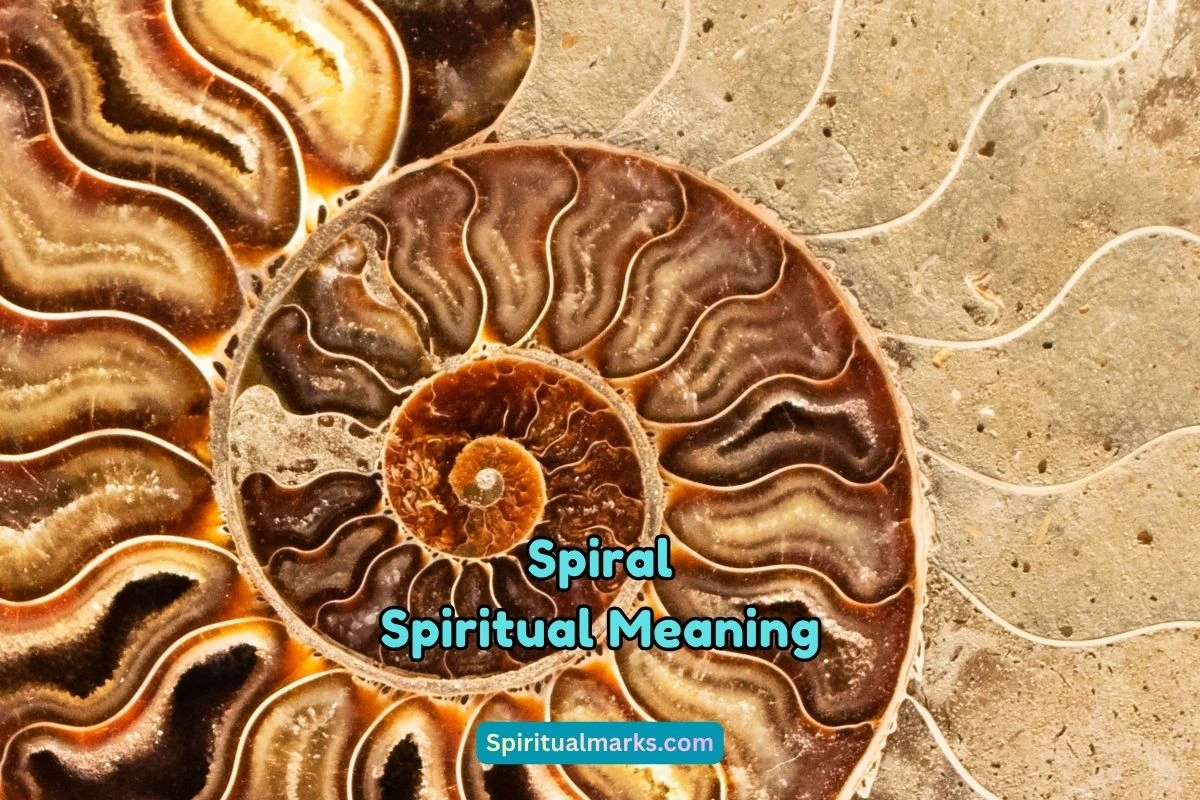
You have seen it carved into ancient stone. You have spotted it in galaxies, seashells, and fingerprints. The spiral is everywhere. It shows up in nature, art, architecture, and sacred traditions spanning thousands of years. But what does it actually mean spiritually?
The spiral spiritual meaning is rich, layered, and deeply personal. It speaks of growth, transformation, the soul’s journey, and the eternal rhythm of life. Ancient cultures on every continent recognized the spiral as something sacred. They carved it into temples, painted it on pottery, and wove it into their stories of creation and death.
This is not a coincidence. When something appears universally, across cultures that never met, it carries weight. The spiral is one of those symbols. It connects the inner world to the outer one. It links the physical to the divine. It marks the path from who you were to who you are becoming.
Whether you spotted a spiral in a dream, feel drawn to the shape, or want to understand what your spiral tattoo or jewelry really means, this post covers it all. Every type, every tradition, every layer of meaning.
Key Takeaways
- The spiral is one of the oldest spiritual symbols in human history, found in cultures on every continent dating back over 5,000 years.
- Spiritually, the spiral represents growth, evolution, transformation, and the soul’s continuous journey through life cycles.
- Different types of spirals carry distinct meanings. The double spiral symbolizes balance, the golden spiral reflects divine proportion, and the Celtic triple spiral points to the Holy Trinity or the threefold nature of life.
- In major world religions including Christianity, Hinduism, and Indigenous traditions, the spiral holds significant sacred meaning connected to creation, divine energy, and the cosmos.
- Seeing a spiral in a dream often signals personal growth, a new phase of life, or a call to look inward and trust the process of transformation.
What Is the Spiral Symbol and Why Does It Hold Spiritual Power?
The spiral is a curve that starts from a central point and moves outward in a continuously expanding pattern, or inward in a contracting one. That simple geometry carries enormous spiritual weight.
Why? Because the spiral mirrors life itself. Everything in nature spirals. DNA double-helixes. Galaxies rotate in spiral arms. Hurricanes form spiraling bands. The nautilus shell follows a perfect logarithmic spiral. Even the human fingerprint spirals inward to a unique center.
When ancient people looked at the world around them, they saw the spiral everywhere. It felt alive. It felt intentional. To them, it was not random. It was a sign that the universe was organized around a fundamental principle of expansion and return.
The spiritual power of the spiral lies in its dual movement. It goes outward, expanding and growing. But it also curves back, suggesting return, reflection, and renewal. This duality made it a natural symbol for the cycles of life, death, and rebirth. It told the story of a soul that journeys far but always finds its way back to its center.
Ancient Neolithic peoples carved spirals into stones at sites like Newgrange in Ireland around 3200 BCE, predating Stonehenge. These carvings were not decorative. They were placed at solar-aligned passage tombs, connecting the spiral to the sun, seasons, and the journey of the dead into the next life. That is how seriously our ancestors took this symbol.
What Does Seeing a Spiral Symbolize or Represent?
Seeing a spiral, whether in real life, in art, or in a recurring pattern that keeps catching your eye, is often considered a spiritual message. The meaning shifts depending on the context, but the core themes remain consistent.
Seeing a spiral means growth is happening. Even when life feels chaotic or slow, the spiral reminds you that you are not standing still. You are moving. You may circle back to old themes, but you are approaching them from a higher level of awareness. That is the spiral’s promise.
It also symbolizes spiritual awakening. Many people report a sudden attraction to spirals right before a major life shift. A divorce. A career change. A spiritual breakthrough. The spiral appears as a kind of cosmic nudge, telling you that transformation is underway.
Seeing a spiral can also represent energy flow. In many energy healing traditions, the spiral is used to visualize how life force or prana moves through the body and the environment. A spiral drawn or visualized during meditation is believed to direct healing energy toward a specific area.
On a deeper level, the spiral represents the self meeting the infinite. It starts at a single point, your individual identity, and expands outward toward the boundless cosmos. Or it spirals inward, moving from the noise of the world back toward your true center. Both directions carry profound spiritual meaning.
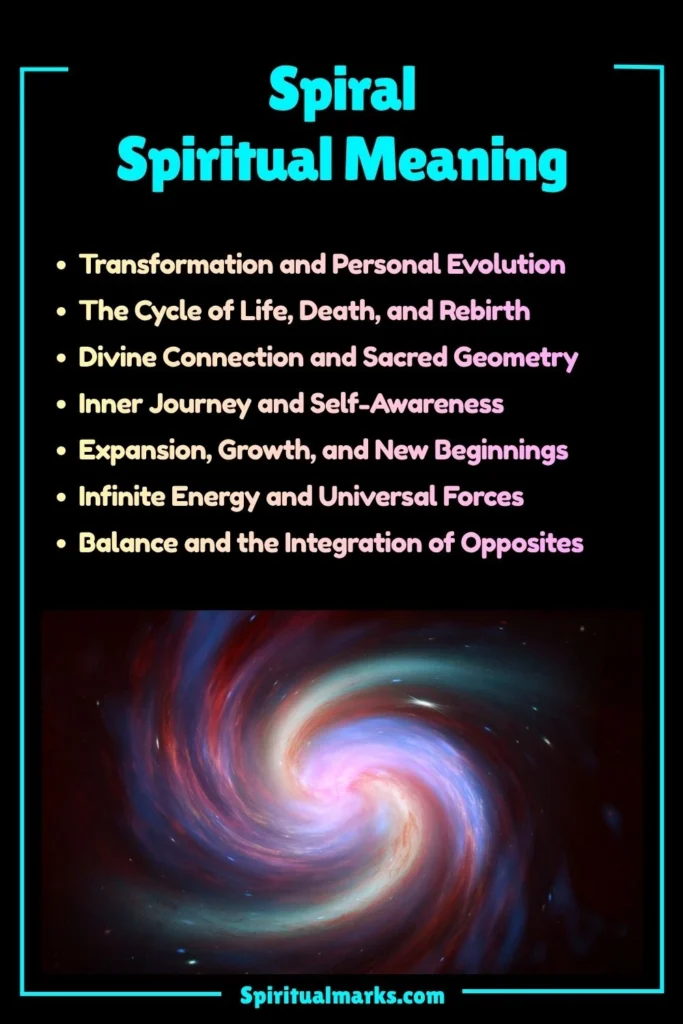
7 Spiritual Meanings of the Spiral
1. Transformation and Personal Evolution
The spiral is the ultimate symbol of transformation. Unlike a straight line that moves from point A to point B, the spiral circles back. It revisits. It returns to familiar ground. But each time it returns, it does so from a wider, more elevated perspective.
This mirrors the human spiritual journey perfectly. You do not grow in a straight line. You revisit old wounds, old patterns, and old questions. But if you are evolving, you approach them differently each time. You carry more wisdom, more compassion, more awareness. The spiral holds this truth without apology.
In Jungian psychology, this process is called individuation. It is the lifelong journey of becoming fully yourself, not just the self shaped by others’ expectations, but the authentic, whole self that integrates all parts of your experience. The spiral is the map for that journey. It suggests that every return to an old theme is not regression. It is a new orbit at a higher altitude.
Many spiritual teachers across traditions describe personal growth using spiral metaphors. The Sufi concept of the whirling dervish mirrors this. Spinning in sacred circles, the dervish moves outward while remaining centered on the divine. The body spirals; the soul rises.
2. The Cycle of Life, Death, and Rebirth
Long before written religion, humans used the spiral to mark the cycle of birth, death, and rebirth. The Newgrange passage tomb in Ireland is the most striking example. Built over 5,000 years ago, it is aligned with the winter solstice sunrise. Triple spirals carved at its entrance welcomed the sun’s light back into the tomb of the dead each year, symbolizing the return of life from darkness.
This cycle is at the heart of most world spiritual traditions. In Hinduism, it mirrors the cycles of creation, preservation, and destruction governed by the Trimurti. In Buddhism, it reflects the wheel of samsara, the continuous cycle of death and rebirth that the soul must transcend. In Celtic spirituality, the spiral marks the turning of the seasons and the endless dance of life.
The spiral does not just acknowledge death. It reframes it. Death is not an ending in spiral symbolism. It is a turn in the path. The energy contracts inward at the end of one life and then expands outward again in the next. This perspective has comforted countless cultures across millennia.
Even modern science echoes this. Energy does not disappear. It transforms. The law of conservation of energy mirrors what spiral symbolism taught long ago. Nothing is truly lost. Everything cycles. Everything spirals.
3. Divine Connection and Sacred Geometry
The spiral appears in sacred geometry as one of the most fundamental expressions of divine order. Sacred geometry is the idea that certain mathematical patterns and shapes underlie the structure of reality itself. The spiral, specifically the logarithmic or golden spiral, is one of the most revered of these patterns.
The golden spiral is based on the golden ratio, approximately 1.618, a proportion found in nautilus shells, sunflower seeds, galaxy arms, and the human body. Ancient architects used it in the Parthenon. Leonardo da Vinci embedded it in his artworks. To those who study sacred geometry, the golden spiral is evidence of divine intelligence woven into the fabric of creation.
Spiritually, this means that the spiral is not just a symbol humans invented. It is a pattern that the divine inscribed into reality. When you see a spiral, you are seeing God’s handwriting, or the universe’s signature, depending on your belief system. You are witnessing the same mathematical language that organizes everything from the tiniest shell to the largest galaxy.
Meditating on the spiral, or working with it as a yantra or mandala, is considered a way to align yourself with this divine order. Many practitioners believe that spiraling patterns in sacred geometry can open energy centers in the body and create pathways for spiritual insight and healing.
4. Inner Journey and Self-Awareness
One of the most intimate spiritual meanings of the spiral is the inward journey. When the spiral moves from the outside in, it represents the soul’s movement away from external noise and toward inner truth. This is the journey of self-awareness and spiritual introspection.
Many meditative traditions use the image of a spiral path leading inward to the center. That center is the self, the still point, the place of pure awareness that exists beneath all the layers of personality, trauma, and conditioning. The spiral path is the work of getting there. It is the years of prayer, meditation, therapy, and honest self-examination.
In Kabbalah, the Jewish mystical tradition, the path to understanding the Ein Sof (the infinite divine) is not linear. It spirals through the Sefirot, the ten divine attributes on the Tree of Life. Each Sefirah visited brings the seeker closer to the center of divine being. The spiral is built into the very architecture of the mystical journey.
The inward spiral also represents entering the mystery. Ancient temples and sacred sites were often built in spiral configurations or with spiraling paths leading to the inner sanctuary. Walking that path was not just physical. It was a ritual act of entering sacred space, leaving the ordinary world behind, and preparing the soul for divine encounter.
5. Expansion, Growth, and New Beginnings
The outward spiral is a symbol of expansion, abundance, and the courage to grow beyond what is known. When the spiral moves from the center outward, it represents the soul reaching into new territory. It is the symbol of a seedling pushing through soil, a life force that refuses to be contained.
Many people feel drawn to spiral imagery during periods of major growth or new beginnings. A new business, a new relationship, a new spiritual practice. The spiral validates that movement. It says that expansion is not reckless. It is natural. It is the universe’s way.
In feng shui, spiral shapes and motifs are associated with flowing energy and abundance. Spiral staircases, spiral water features, and spiral artwork are used to encourage positive energy circulation through a space. This is based on the understanding that energy, like water, moves best when it can spiral and flow freely.
The spiral as new beginnings also appears powerfully in Indigenous American traditions. The spiral petroglyph, found at sacred sites across the American Southwest, is often connected to the sun, the seasons, and the beginning of a new cycle. When the light hit these carvings at the solstice, it confirmed that the world was renewing itself. Life was beginning again.
6. Infinite Energy and Universal Forces
The spiral is one of the most powerful symbols of energy in motion. Every natural force that has enough power and time will organize itself into a spiral. Tornadoes, whirlpools, hurricanes, and galaxies all spiral. This is not poetic. It is physics. Rotational forces naturally produce spiral patterns.
Spiritually, this gives the spiral enormous significance as a symbol of cosmic power and universal energy. Ancient shamans and energy healers understood this intuitively. They used spiral drawings and movements in rituals designed to call down or direct spiritual energy. The spiral was a conduit, a shape that could channel power from the unseen world into the visible one.
In Kundalini yoga, the foundational life force energy is described as a coiled serpent spiral resting at the base of the spine. As spiritual practice deepens, this energy uncoils and rises in a spiral pattern through the chakras, ultimately reaching the crown and producing enlightenment or spiritual liberation. The spiral is not just metaphor here. It describes the literal movement of pranic energy through the subtle body.
The spiral also connects to the concept of vortex energy in modern spiritual thought. Many sacred sites around the world, including Sedona in Arizona and Glastonbury Tor in England, are believed to sit on energy vortexes. The energy at these sites is described as moving in spiraling patterns, and visitors often report intense spiritual experiences, visions, and physical sensations at these locations.
7. Balance and the Integration of Opposites
The spiral holds opposites in tension. It moves both inward and outward. It expands and contracts. It is both single and infinite. This makes it a powerful symbol of balance and the integration of opposing forces.
In many traditions, the double spiral specifically represents this balance. Two spirals facing each other or connected at their centers symbolize the meeting of two equal forces. Light and dark. Masculine and feminine. Life and death. Yin and yang. This is not conflict. It is the sacred dance of opposites that sustains the universe.
The ancient Chinese concept of Tao carries this meaning deeply. The Tao is the way of balance, the path that integrates all opposites without eliminating either. The spiral is a visual representation of how the Tao moves. It does not choose one direction. It includes both, weaving them into a single flowing path.
In personal spiritual terms, this meaning of the spiral challenges you to stop seeing your life in black and white. Your struggles and your strengths are both part of the spiral. Your past and your future are both contained in its curves. The spiral invites you to hold your contradictions with grace and curiosity rather than judgment, knowing that integration, not perfection, is the goal.
Types of Spiral Symbols and Their Spiritual Meanings
The Single Spiral
The single spiral is the most basic and ancient form. It moves either inward or outward from a central point. Spiritually, it represents the journey of a single soul through life. The inward-moving single spiral points to introspection, stillness, and the search for inner truth. The outward-moving single spiral points to expansion, creativity, and bringing your inner gifts into the world.
The Double Spiral (S-Spiral or Contra Spiral)
The double spiral features two spirals connected at their center, one moving clockwise and one counterclockwise. This is a powerful symbol of duality and balance. It represents the union of opposites: masculine and feminine, life and death, the conscious and unconscious mind. In Celtic tradition, it was associated with the equinoxes, when day and night are perfectly balanced. Many people wear or draw the double spiral as a reminder to seek balance in their own lives.
The Triple Spiral (Triskelion or Triskele)
The triple spiral, also called the triskelion or triskele, consists of three interlocking spirals. It is one of the most recognized symbols in Celtic spirituality and was carved into the stones of Newgrange around 3200 BCE. The triple spiral has multiple layered meanings. It can represent land, sea, and sky. It can symbolize past, present, and future. Many Christians interpret it as representing the Holy Trinity. Others connect it to the three phases of womanhood: maiden, mother, and crone. However you read it, the triple spiral carries themes of threefold power, completeness, and eternal motion.
The Golden Spiral (Logarithmic Spiral)
The golden spiral is built on the mathematical golden ratio (phi, approximately 1.618). It appears in nature with stunning regularity: the nautilus shell, the arrangement of sunflower seeds, the curl of a fern frond, the arms of spiral galaxies. Spiritually, the golden spiral represents divine order, perfection, and the harmony of the universe. It is considered one of the purest expressions of sacred geometry. Working with the golden spiral in meditation or art is believed to align the practitioner with the fundamental mathematical structure of creation.
The Fibonacci Spiral
The Fibonacci spiral is closely related to the golden spiral and is generated by the famous Fibonacci sequence (0, 1, 1, 2, 3, 5, 8, 13…). Each number is the sum of the two before it, and as the sequence grows, the ratio between consecutive numbers approaches the golden ratio. The Fibonacci spiral appears throughout nature in the same places as the golden spiral. Spiritually, it is associated with natural growth patterns, organic unfolding, and the intelligence of the natural world. It suggests that healthy spiritual growth follows a natural, unhurried pattern, not forced or rushed, but unfolding according to its own inner logic.
The Labyrinth Spiral
The labyrinth is technically a spiral path that winds toward a central point and then winds back out again. Unlike a maze, a labyrinth has one path. You cannot get lost. Walking a labyrinth is a contemplative spiritual practice found in traditions as varied as medieval Christianity, Greek mythology, and Native American spirituality. The inward walk represents letting go of the outer world and moving toward your center. The moment at the center is stillness, prayer, or insight. The outward walk represents carrying that insight back into the world. Many cathedrals, including Chartres in France, have famous labyrinth floors used for prayer and pilgrimage.
The Kundalini Spiral
In yogic and Hindu traditions, the Kundalini is depicted as a coiled serpent spiraling at the base of the spine. It is the primal life force energy, sometimes called shakti. Through dedicated spiritual practice, yoga, meditation, and breathwork, this energy is said to uncoil and rise through the seven chakras in a spiraling path. When it reaches the crown chakra, it produces spiritual awakening or samadhi. The Kundalini spiral is one of the most transformative symbols in all of spiritual tradition. It represents latent divine power waiting to be awakened within every human being.
Spiral Meaning and Symbolism Across Cultures and Religions
Celtic Spiral Symbolism
The Celts were perhaps the culture most deeply identified with the spiral symbol. Celtic art is saturated with spiraling knotwork, triskeles, and flowing curved patterns. For the Celts, the spiral was inseparable from their view of time and the cosmos. Time was not linear. It was cyclical, spiraling through the seasons and the ages.
The triple spiral at Newgrange is the oldest evidence of Celtic spiral reverence, predating the Celts themselves and suggesting that the symbolism was inherited from even earlier Neolithic traditions of the British Isles. Celtic druids used spirals in ceremony and spiritual instruction. The spiral was connected to the Otherworld, the realm of the gods and the dead, and to the passage between worlds.
In Celtic tradition, the spiral also represented personal spiritual growth. Moving through life was understood as a spiral journey. You would encounter the same challenges and questions repeatedly, but each time from a deeper, more mature place.
Hindu and Vedic Spiral Symbolism
In Hinduism, the spiral appears in multiple sacred contexts. The conch shell or shankha is a sacred spiral object used in puja ceremonies and associated with the god Vishnu. Its spiral form represents the sound of creation (Om) and the infinite expansion of the universe. The sound it produces when blown is believed to clear negative energy and call the divine into sacred space.
The Kundalini, described above, is the most direct spiral symbol in Hindu and yogic tradition. But spirals also appear in the geometric patterns of mandalas and yantras used for meditation. The Sri Yantra, one of the most sacred geometric forms in Hinduism, contains spiral dynamics within its interlocking triangles, representing the union of Shiva and Shakti, masculine and feminine divine energies.
Indigenous and Shamanic Spiral Symbolism
For many Indigenous cultures around the world, the spiral is a map of the cosmos and a symbol of the sun, water, and the cycle of life. In the American Southwest, the Ancestral Puebloans (Anasazi) carved spiral petroglyphs at sites that align with the solstices and equinoxes. At Chaco Canyon in New Mexico, a famous spiral petroglyph receives a precise dagger of light at solar noon on the summer solstice, suggesting these were sophisticated astronomical and spiritual markers.
In Australian Aboriginal spirituality, spiral symbols appear in sand drawings and rock art connected to the Dreamtime, the sacred dimension of creation and ancestral stories. The spiral in this context often represents water, whirlpools, or the movement of spiritual energy through the landscape.
Maori culture in New Zealand uses the koru, an unfolding spiral based on the silver fern frond, as one of its most cherished symbols. The koru represents new life, growth, strength, and peace. It is used widely in Maori art, tattoo (ta moko), and spiritual ceremony, affirming that new beginnings always unfold from a strong center.
Japanese and East Asian Spiral Symbolism
In Japanese culture, the tomoe is a comma-shaped spiral symbol that appears on Shinto shrines and Japanese family crests (mon). The mitsudomoe, a triple tomoe, is one of the most common symbols in Japanese spirituality. It represents the dynamic balance of heaven, earth, and humanity, or in some contexts, the relationship between the three forces of creation, preservation, and destruction. The tomoe is also associated with the god Hachiman, a major Shinto deity connected to war, arrows, and divine protection.
In Chinese spirituality, spiral forms are embedded in concepts like the Tao and in traditional depictions of dragons, whose coiling, spiral bodies represent the cosmic life force that animates the natural world.
Spiral Symbolism in World Mythologies
Greek Mythology and the Spiral
In Greek mythology, the spiral appears most dramatically in the myth of the Labyrinth of Crete, created by the master craftsman Daedalus to contain the Minotaur. Theseus used a thread to spiral his way into the center of the labyrinth and back out again, a narrative that mirrors the hero’s journey into the depths of the unknown and the return with new wisdom.
The spiral also appears in myths of Ariadne, whose name is connected to the thread that saved Theseus. Ariadne represents feminine wisdom and the guidance of intuition through the darkest, most confusing passages of life. Her thread is the spiral path made visible.
The myth of Persephone spiraling into the underworld each autumn and returning each spring is another powerful spiral narrative. It gave ancient Greeks a spiritual framework for understanding seasonal death and renewal, and by extension, their own losses and revivals.
Norse Mythology and the Spiral
In Norse tradition, the Valknut, a symbol of three interlocking triangles, shares the triple-spiral energy of the triskelion. It is associated with Odin, the chief god, and with the transition between life and death. Norse mythology saw the cosmos as inherently spiral in nature. The world tree Yggdrasil connects nine realms in a spiral of cosmic relationship, and Jormungandr, the World Serpent, coils in a spiral around the entire world, holding creation together through its circular grip.
The Norse concept of the cosmic cycle, moving from creation through Ragnarok and back to a new creation, is itself a spiral narrative. The world spirals through destruction into rebirth, the same eternal cycle the spiral has always represented.
Egyptian Mythology and the Spiral
In ancient Egypt, the spiral appeared in the coiled form of Apep (Apophis), the serpent of chaos that the sun god Ra battled every night as he journeyed through the underworld. The nightly spiral journey of Ra through the twelve hours of darkness and his triumphant return at dawn was the ultimate spiral narrative of death and rebirth, repeated daily as a cosmic guarantee that life would always overcome darkness.
The ammonite fossil, a naturally spiraling shell found throughout the ancient world including Egypt, was considered sacred. Ancient Egyptians called it the horn of Ammon, associated with the ram-headed god Amun, whose name means the hidden one, the divine that spirals into mystery and returns as light.
Spiral Symbolism in Major World Religions
Spiral Biblical Meaning and Significance
The Bible does not use the word spiral directly, but spiral themes and imagery run throughout scripture. The pillar of cloud by day and fire by night that guided the Israelites through the desert is often described as a spiraling column of divine presence. It moved, it led, it returned, it covered the Tabernacle. The spiral motion of divine guidance is implicit throughout Exodus.
In the Book of Ezekiel, the prophet’s vision of the divine chariot (merkabah) includes wheels within wheels turning and spiraling in complex patterns, representing the movement of God’s presence through creation. This vision became foundational to Jewish mystical tradition (Merkabah mysticism) and later Kabbalah, both of which feature spiral-like journeys through divine realms.
Solomon’s Temple was built with symbolic spiral elements. The two bronze pillars at its entrance, called Jachin and Boaz, were topped with spiral-carved lily motifs and pomegranate designs, symbolizing life, fertility, and divine favor. The spiral was part of the sacred architecture of the holiest site in ancient Israel.
In the New Testament, the descent of the Holy Spirit is described as coming down in the form of a dove and settling upon Jesus at his baptism. Many artistic depictions show this as a spiraling descent, connecting the divine Spirit’s movement to the ancient spiral symbol of divine energy descending into the human world.
The Book of Revelation contains spiral symbolism in its description of the seven seals, seven trumpets, and seven bowls. These spiraling cycles of sevens represent the spiraling completion of cosmic history, moving in layers toward the final restoration of all things.
Islamic Perspectives on the Spiral
While Islamic art avoids figurative representation, it embraces geometric and arabesque patterns with deep spiritual meaning. Many Islamic geometric patterns incorporate spiral motifs and flowing arabesque curves that represent the infinite nature of God (Allah) and the ceaseless motion of creation. The spiral in Islamic sacred art points toward the Infinite, the mathematical endlessness of the spiral mirroring the divine attribute of Al-Baqi (the Everlasting).
The Sufi tradition within Islam is perhaps the most explicitly spiral in its spirituality. The whirling ceremony of the Mevlevi Order (founded by followers of Rumi) involves spinning in a deliberate, sacred spiral motion. The whirling dervish turns the left arm downward, receiving from the earth, and the right arm upward, receiving from heaven. The spiraling body becomes a human axis between earth and sky, a living symbol of divine energy circulating between worlds.
Dreaming About Spirals: Spiritual and Psychological Meanings
Dreams featuring spirals are considered highly significant in both spiritual traditions and depth psychology. The meaning shifts depending on how the spiral moves and how it makes you feel.
Dreaming of a spiral moving inward generally points to a period of deep introspection, withdrawal, or spiritual seeking. Your unconscious is calling you inward. Something important is waiting at your center. This dream often appears during times of life transition, when external distractions have stripped away and something truer is demanding your attention.
Dreaming of a spiral moving outward signals expansion, creativity, and readiness to share your gifts with the world. You are coming out of a period of inner work. You are ready to grow, create, or connect. This dream can also signal a new beginning or a major opening in your life, romantic, professional, or spiritual.
A spiral that feels threatening or consuming in a dream can represent feeling overwhelmed, stuck in repetitive patterns, or lost in a cycle you cannot escape. This is the shadow side of the spiral. It asks whether you are growing through your repeated experiences or simply repeating them out of fear or habit.
A golden or luminous spiral in a dream is widely considered a blessing or divine communication. In many spiritual traditions, bright light in dreams indicates divine presence or guidance. A golden spiral dream may signal that you are moving in alignment with your soul’s purpose and that spiritual support is with you.
Carl Jung wrote extensively about spiral imagery in dreams as a manifestation of the individuation process, the lifelong journey toward psychological and spiritual wholeness. He noted that spiral dreams often appeared at major turning points in a person’s inner development, marking the transition from one level of self-awareness to the next.
The Spiritual Meaning of Spiral Tattoos and Jewelry
Many people carry the spiral on their bodies or around their necks as a personal spiritual statement. The meaning is often deeply individual, but certain themes emerge consistently.
A spiral tattoo on the wrist or hand is often chosen by people who see themselves as creative, spiritually evolving, or guided by intuition. Placing the spiral where it is constantly visible serves as a reminder of their commitment to growth and self-discovery.
The Celtic triple spiral tattoo is one of the most popular choices. It honors Celtic heritage while carrying the deep meaning of eternal cycles, divine threeness, and the interconnection of all life stages. Many people choose it to mark a major transformation in their life.
Spiral jewelry carries the same symbolism. Wearing a spiral pendant or ring is a way of keeping the energy of transformation and growth close. In some spiritual practices, spiral jewelry is cleansed and charged with intention, making it a personal talisman for spiritual protection, growth, or healing.
Summary Table: Spiral Spiritual Meaning at a Glance
| Aspect | Meaning |
|---|---|
| Core Spiritual Meaning | Growth, transformation, the soul’s journey, eternal cycles |
| Single Spiral (Inward) | Introspection, inner truth, spiritual searching |
| Single Spiral (Outward) | Expansion, creativity, new beginnings |
| Double Spiral | Balance, duality, union of opposites |
| Triple Spiral (Triskelion) | Holy Trinity, land/sea/sky, past/present/future |
| Golden Spiral | Divine order, sacred geometry, universal perfection |
| Fibonacci Spiral | Natural growth, organic unfolding, nature’s intelligence |
| Labyrinth Spiral | Spiritual pilgrimage, descent and return, self-discovery |
| Kundalini Spiral | Primal life force energy, spiritual awakening |
| Celtic Tradition | Eternal cycles, the Otherworld, spiritual evolution |
| Hindu Tradition | Creation sound, life force energy, divine union |
| Indigenous Traditions | Sun cycles, water, ancestral wisdom, cosmic renewal |
| Biblical Symbolism | Divine guidance, Holy Spirit, cosmic completion |
| Sufi Tradition | Sacred spinning, divine union, energy between worlds |
| Dream Meaning (Inward) | Need for introspection, inner calling, life transition |
| Dream Meaning (Outward) | Expansion, readiness to grow, new beginnings |
| Spiral Tattoo | Personal transformation, spiritual commitment, Celtic heritage |
A Final Note
The spiral spiritual meaning has endured for over 5,000 years because it tells the truth about how life actually works. You do not grow in straight lines. You circle back. You revisit. You expand. You return to your center. And each time, you arrive carrying more of who you truly are.
Whether you encounter the spiral in a dream, feel drawn to its shape in art and jewelry, or find yourself noticing it in nature, pay attention. It is one of the most reliable messengers the universe has ever used. It speaks of transformation in progress, divine order beneath the chaos, and the soul’s unending movement toward wholeness.
If you want to work more intentionally with spiral energy, try drawing spirals in your journal during times of transition. You might also consider meditating on a golden spiral image to align yourself with divine proportion and sacred order. Walking a labyrinth, either a physical one or a drawn one traced with your finger, can also be a powerful way to internalize the spiral’s wisdom of going in and coming back out changed.
The spiral does not promise a destination. It promises a worthy journey. And sometimes, that is exactly what the soul needs most.