Why Numbers in the Bible Are Never Random
You have probably read a Bible passage and paused at a specific number. Why forty days? Why seven churches? Why twelve tribes? These are not arbitrary details. Prophetic numbers in the Bible carry layers of meaning that go far beyond counting or measurement.
The ancient Hebrew and Greek languages both assigned numerical values to letters. This practice, known as gematria, made numbers a natural vehicle for divine communication. Biblical writers understood numbers as part of God’s symbolic language, a language that encoded truth, foreshadowed events, and revealed divine order.
Across 66 books, written over 1,500 years, by more than 40 authors, the same numerical patterns appear with astonishing consistency. This consistency is not coincidence. It points to a unified intelligence behind the text. When you study prophetic numbers in the Bible, you begin to see Scripture not just as history or poetry but as a carefully structured prophetic code.
This blog post unpacks that code in full. You will find scripture references, cultural context, theological significance, and connections between the Old and New Testaments that reveal just how deeply numbers are woven into the fabric of biblical revelation.
Key Takeaways
- Numbers in the Bible function as prophetic symbols, not merely as quantities. Each significant number carries theological and spiritual meaning rooted in Hebrew tradition and divine design.
- The number seven is the most prominent prophetic number, representing divine completeness and appearing hundreds of times across both Testaments, from Genesis to Revelation.
- Numbers like 40, 12, and 3 consistently mark periods of testing, divine governance, and divine unity, creating a symbolic vocabulary that threads through the entire biblical narrative.
- The number 666 is one of the most prophetically significant numbers in Scripture, connected to the Beast in Revelation and understood as a symbol of human imperfection and rebellion against God.
- Biblical numerology is not the same as occult numerology. It is a legitimate field of biblical study rooted in the cultural, historical, and literary context of Scripture, used by scholars and theologians for centuries.
What Is Biblical Numerology and How Does It Work?
Biblical numerology is the study of numbers in Scripture and the symbolic meanings they carry. Unlike occult numerology, which assigns meaning to numbers based on mystical or astrological frameworks, biblical numerology is grounded in the context of Scripture itself.
The meanings of biblical numbers are consistent across books, genres, and time periods. A number like twelve means divine government or apostolic completeness whether it appears in the twelve tribes of Israel in Genesis or the twelve apostles in the New Testament. This internal consistency gives biblical numerology its credibility.
Hebrew thought did not separate the spiritual from the physical. Numbers were not just math. They were theological statements. When God commanded Noah to spend forty days in the ark, or when Jesus fasted for forty days in the desert, the number was not incidental. It communicated a specific spiritual reality: a period of testing, transition, and divine preparation.
Scholars like E.W. Bullinger, who wrote the foundational work Number in Scripture (1894), spent decades documenting these patterns. His research demonstrated that numbers like 3, 6, 7, 12, and 40 carry meanings that are externally verifiable through consistent biblical usage.
The Most Significant Prophetic Numbers in the Bible
The Number 1: Divine Unity and Sovereignty
One is the foundation of all biblical numerology. It speaks of the absolute unity and sovereignty of God. Deuteronomy 6:4 declares: “Hear, O Israel: The Lord our God, the Lord is one.” This verse, known as the Shema, is the cornerstone of Hebrew theology. God’s oneness is not just numerical. It is categorical.
The number one also carries prophetic weight in its representation of new beginnings. Revelation 21:1 speaks of “a new heaven and a new earth,” with the old passing away. In prophetic literature, one marks the start of something entirely new.
Jesus prayed for unity using this number as the standard. In John 17:21, He prayed that believers “may all be one, just as you, Father, are in me, and I in you.” The oneness of the Trinity becomes the blueprint for the unity of the church.
When one appears in prophetic passages, it consistently signals the primacy of God, the singularity of His purpose, or the inauguration of a new divine order. It sets the stage for everything that follows.
The Number 3: The Trinity, Resurrection, and Divine Completeness
Three is one of the most theologically rich numbers in all of Scripture. It represents the Trinity: Father, Son, and Holy Spirit. It is the number of divine completeness in its most perfect and relational form.
Jesus rose from the dead on the third day (1 Corinthians 15:4). Jonah was in the belly of the fish for three days and three nights (Jonah 1:17). Jesus himself used Jonah’s three days as a sign of His own resurrection (Matthew 12:40). The pattern repeats because the number itself carries prophetic weight.
Three witnesses establish truth in biblical law (Deuteronomy 19:15). Three are also the witnesses in 1 John 5:7-8: the Spirit, the water, and the blood. Peter denied Jesus three times (Luke 22:34). Jesus restored him three times (John 21:15-17). The repetition of three marks the fullness of an event, confirming it as divinely complete.
In prophetic literature, three marks divine validation. When something happens three times in Scripture, it is not a literary accident. It is a signal that God has confirmed, completed, or sealed something of eternal significance. Isaiah saw the seraphim crying “Holy, holy, holy” in triplicate (Isaiah 6:3), which is the most emphatic affirmation of God’s holiness in all of Scripture.
The Number 4: Creation, the Earth, and Universal Scope
Four represents the created world and its universality. There are four corners of the earth (Revelation 7:1), four winds of heaven (Daniel 7:2), four seasons, and four cardinal directions. When the Bible uses four in a prophetic context, it is signaling something that applies to all of creation or to the entire inhabited world.
Ezekiel’s famous vision of the four living creatures (Ezekiel 1:5-10) connects four to the fullness of God’s created order. These four creatures reappear in Revelation 4:6-8, confirming their cosmic and prophetic significance. Each creature represents a different aspect of God’s creation: lion (wild animals), ox (domestic animals), eagle (birds), and man (humanity).
The four Gospels themselves reflect this principle. Matthew, Mark, Luke, and John each present a unique angle on Jesus, together forming a complete, fourfold witness to His life, death, and resurrection. The number four in this context signals completeness of testimony.
In Daniel’s vision, four great beasts rise from the sea (Daniel 7:3), each representing a world empire. The use of four is intentional: these empires cover the full scope of Gentile world power before the coming of God’s eternal kingdom.
The Number 6: Human Imperfection and Incompleteness
Six falls one short of seven, and that gap is theologically intentional. Six is the number of humanity and human effort apart from God. Man was created on the sixth day (Genesis 1:26-31). The number six signals that humanity, in its fallen state, always falls short of divine perfection.
The most famous use of six is the number 666, the “number of the beast” in Revelation 13:18. The triple repetition amplifies human imperfection to its ultimate degree. Most scholars interpret 666 as the fullness of human rebellion, a number that represents a counterfeit trinity: Satan, the Antichrist, and the False Prophet, each falling short of divine glory.
Historically, early Christians used 666 to identify Nero Caesar, whose name in Hebrew gematria totals 666. This was a form of coded communication under Roman persecution. However, the prophetic application of 666 extends beyond any single historical figure. It points to any system or power that exalts itself against God.
Six also appears in human labor and commerce. The Israelites worked for six days and rested on the seventh (Exodus 20:9-10). Slaves served for six years before being freed in the seventh (Deuteronomy 15:12). The pattern consistently frames six as the domain of human work and limitation, always pointing toward the divine rest that the seventh brings.
The Number 7: Divine Perfection, Completeness, and Covenant
Seven is the most prominent prophetic number in the entire Bible. It appears over 700 times across both Testaments. Seven represents divine perfection, completeness, and the fullness of God’s covenant. No other number is more consistently associated with God’s nature and activity.
God created the world in six days and rested on the seventh (Genesis 2:2). The Sabbath, rooted in the number seven, became the foundation of Hebrew covenant life. The seven-year cycle led to the Year of Jubilee after seven times seven years (Leviticus 25:8-10). Seven is built into the very architecture of Israel’s calendar, economy, and worship.
The book of Revelation is saturated with sevens. There are seven churches (Revelation 1:20), seven seals (Revelation 5:1), seven trumpets (Revelation 8:2), seven bowls of wrath (Revelation 16:1), and seven spirits of God (Revelation 1:4). This sevenfold structure is not coincidental. It signals that the events of Revelation are divinely complete and absolutely certain.
In Proverbs 9:1, Wisdom builds her house on seven pillars. The seven “I Am” statements of Jesus in John’s Gospel reveal the fullness of His divine identity. Naaman dipped in the Jordan seven times before his healing (2 Kings 5:14). Seven marks the point at which God’s will is fully accomplished. When you see seven in Scripture, you are witnessing the signature of divine completion.
The Number 8: New Beginnings and Resurrection
Eight follows seven, and that sequence is deeply prophetic. After the complete cycle of seven, eight marks a new beginning. It is the number of resurrection, renewal, and the start of a new era.
Eight people were saved on Noah’s ark (1 Peter 3:20), beginning a new chapter in human history after the flood. Circumcision was performed on the eighth day (Genesis 17:12), marking a child’s covenant entry into a new relationship with God. Jesus rose from the dead on the first day of the week, which was also the eighth day in the weekly cycle, signifying the inauguration of a new creation.
The early church fathers recognized eight as the number of the new covenant and resurrection life. Early Christian baptisteries were often built with eight sides, a deliberate architectural choice that connected baptism to the symbolism of new beginning that eight carries.
John wrote the book of Revelation on Patmos, and he received his vision “on the Lord’s Day” (Revelation 1:10), the first day, the eighth day, the day of resurrection. The prophetic message of Revelation is itself an eighth-day vision: a revelation of the new creation that awaits beyond the completion of the present age.
The Number 12: Divine Government and Apostolic Authority
Twelve is the number of divine government. It appears repeatedly in contexts of leadership, authority, and God’s organized community. There were twelve tribes of Israel (Genesis 49), twelve apostles chosen by Jesus (Matthew 10:1-4), and twelve gates and twelve foundations in the New Jerusalem (Revelation 21:12-14).
The twelve sons of Jacob became the twelve tribes, the organized community through which God administered His covenant on earth. The twelve apostles of Jesus became the foundation of the new covenant community. The parallel is not accidental. Both structures reflect the same principle: God governs His people through a structured, twelve-fold authority.
In Revelation 7:4-8, 144,000 are sealed from the twelve tribes of Israel. This number is twelve times twelve times one thousand, an amplification of divine government to its most complete expression. Whether 144,000 is literal or symbolic, it speaks of the fullness of God’s covenant people under divine protection.
The New Jerusalem itself is built on the number twelve. Its walls are 144 cubits high (Revelation 21:17), its gates are adorned with the names of the twelve tribes, and its foundations bear the names of the twelve apostles. The entire eternal city is structured around the number of divine government. God’s ultimate dwelling with humanity is ordered, covenantal, and complete.
The Number 40: Testing, Trials, and Divine Preparation
Forty is the number of testing and preparation. No number in Scripture is more consistently associated with periods of trial, purification, and transition than forty. Its appearances span the entire biblical narrative with remarkable consistency.
It rained for forty days and forty nights during the flood (Genesis 7:12). Moses spent forty years in the wildernessbefore his calling (Acts 7:30). The Israelites wandered in the desert for forty years (Numbers 14:33). Moses fasted on Sinai for forty days (Exodus 24:18). Elijah traveled for forty days to reach Horeb (1 Kings 19:8). Jesus fasted for forty days before His public ministry (Matthew 4:2).
The pattern is unmistakable. Forty consistently marks a liminal period, a time between what was and what will be. It is never a comfortable number. It is a number of refinement, where God strips away what is unnecessary and prepares His servants for what lies ahead.
After the forty days of testing, transformation always follows. Moses descended with the Law. The Israelites entered the Promised Land. Jesus launched His ministry with authority. Forty does not end in defeat. It ends in divine commissioning. The trial is the preparation.
In prophetic terms, forty signals that a major transition is imminent. When you see forty in Scripture, pay attention to what comes next. The wilderness always precedes the promised land.
The Number 70: Completeness of Human Government and Divine Judgment
Seventy combines the perfection of seven with the universality of ten, producing a number that speaks of complete human governance under God’s sovereign oversight. It appears in contexts of leadership, judgment, and the fullness of human history.
Seventy elders were appointed to assist Moses in governing Israel (Numbers 11:16). Seventy nations are listed in the Table of Nations in Genesis 10. Jesus sent out seventy disciples (Luke 10:1). Each use carries the sense of comprehensive, ordered governance that covers the full scope of its domain.
The most prophetically significant use of seventy is in Daniel 9:24-27, where Gabriel delivers the prophecy of “seventy weeks,” one of the most studied prophetic passages in all of Scripture. Most scholars interpret these as seventy weeks of years, meaning 490 years, covering the period from the decree to rebuild Jerusalem to the coming of the Messiah and the end of the age.
Jeremiah prophesied seventy years of Babylonian captivity (Jeremiah 25:11-12), and this was fulfilled precisely. The exactness of that fulfillment reinforces the prophetic weight of seventy as a number of complete, measured divine judgment. God’s seventy is not approximate. It is exact, purposeful, and always tied to the fullness of His redemptive plan.
The Number 144,000: The Fullness of God’s Sealed Remnant
144,000 is one of the most debated numbers in prophetic Scripture. It appears in Revelation 7:4 and Revelation 14:1, and it has generated centuries of theological discussion. The number is derived from twelve times twelve times one thousand, making it a threefold amplification of divine government.
Some traditions, like the Jehovah’s Witnesses, interpret 144,000 as a literal count of people who will rule in heaven. Most mainstream theologians understand it as a symbolic representation of the complete covenant community of God, marked and protected during the period of tribulation. The twelve tribes listed in Revelation 7:5-8 differ from the standard Old Testament listing, which suggests symbolic rather than strictly literal intent.
The 144,000 are described as those who follow the Lamb (Revelation 14:4). They bear His name and the Father’s name on their foreheads, standing in direct contrast to those who bear the mark of the beast. The number functions as a prophetic seal of divine ownership, the full complement of God’s faithful people.
Regardless of the precise interpretation, 144,000 communicates absolute divine completeness. Not one of God’s sealed servants is missing. Not one is overlooked. The number assures believers that God’s protection of His remnant is total and perfect.
Prophetic Numbers in Daniel and Revelation: The Apocalyptic Code
The books of Daniel and Revelation are the two most numerically dense prophetic texts in Scripture. Together, they form what scholars call the apocalyptic code, a symbolic language in which numbers, beasts, and visions communicate truths that could not be stated plainly under political persecution.
Daniel’s vision of the four beasts (Daniel 7) uses the number four to represent world empires. Ten horns appear on the fourth beast (Daniel 7:7), and ten is the number of ordinal completeness, representing the full expression of human governmental power before the Ancient of Days establishes His eternal kingdom.
The number 1,260 appears in both Daniel and Revelation. It equals three and a half years, or forty-two months, or time, times, and half a time (Daniel 12:7, Revelation 11:3, Revelation 12:6). This number consistently marks a period of intense tribulation and prophetic activity. It is exactly half of seven years, signaling an incomplete, broken periodof human opposition to God that will not be allowed to reach completion.
The year-day principle, widely used in prophetic interpretation, holds that a prophetic day equals a literal year. Using this principle, Daniel’s 70 weeks (490 days) become 490 years, a period that many scholars believe accurately predicted the arrival of Jesus in Jerusalem. The 2,300 days of Daniel 8:14 become 2,300 years in this same framework, pointing to specific historical fulfillments.
These numbers are not decorative. They are the architecture of divine prophecy, specific enough to be verified historically, broad enough to carry ongoing prophetic significance for future generations of believers.
The Number 666: The Most Feared Prophetic Number Explained
No number in the Bible has generated more fear, speculation, or misunderstanding than 666. Revelation 13:18 states: “This calls for wisdom: let the one who has understanding calculate the number of the beast, for it is the number of a man, and his number is 666.”
The phrase “number of a man” is key. 666 is not the number of a demon or a supernatural being. It is the number of humanity in its most corrupt and God-defiant form. Six, as discussed, is the number of humanity. Three sixes amplify that imperfection to its maximum expression.
Early Christian scholars applied 666 to Nero Caesar using Hebrew gematria. When the letters of Neron Kaisar are transliterated into Hebrew and their values added, the sum is precisely 666. This historical identification was a form of coded prophecy, allowing persecuted Christians to identify their oppressor without endangering themselves with open political speech.
The broader prophetic significance of 666 extends beyond Nero. It represents any system, empire, or individual that opposes God, demands ultimate allegiance, and marks its followers as its own. The contrast in Revelation is stark: those sealed with the name of God (144,000) versus those marked with the number of the beast (Revelation 14:1 vs. Revelation 13:16-17).
Many modern theologians see 666 as a living prophetic symbol, applicable to any age where human systems demand the worship and total allegiance that belongs only to God. The number warns every generation: do not give to any earthly power what belongs to God alone.
Prophetic Number Patterns Across the Old and New Testaments
One of the strongest arguments for the divine authorship of Scripture is the consistency of prophetic number patterns across both Testaments. These patterns were written by different authors, in different languages, across more than a millennium, yet they align with remarkable precision.
The number three appears in Abraham’s three visitors (Genesis 18:2), the three-day journey to Moriah (Genesis 22:4), Jonah’s three days (Jonah 1:17), and Jesus’s three-day resurrection (Matthew 12:40). The pattern does not just repeat; it deepens and fulfills itself progressively.
The number seven structures the creation week (Genesis 1), the Levitical calendar (Leviticus 23), the seventy weeks of Daniel (Daniel 9), and the seven-sealed scroll of Revelation (Revelation 5). Each occurrence adds a layer to the theology of divine completeness.
The number forty links Moses’s wilderness years (Acts 7:30), Israel’s desert wandering (Numbers 14:33), Elijah’s journey (1 Kings 19:8), and Jesus’s temptation (Matthew 4:2) into a single prophetic archetype of preparation and testing that finds its ultimate fulfillment in Christ.
These cross-Testament patterns demonstrate that the biblical authors were working within a shared symbolic framework, one that was not invented but received. The prophetic numbers of the Bible are the fingerprints of a single divine Author working through human voices across centuries.
What the Numbers Say About God’s Character
Studying prophetic numbers in the Bible is not merely an intellectual exercise. These numbers reveal something profound about the character and nature of God Himself.
The prevalence of seven reveals that God is a God of completion. He does not leave things unfinished. His creation is complete. His covenant is complete. His plan of redemption is complete. When Revelation closes with the fullness of sevens, it is declaring that God has finished what He started.
The number forty reveals that God prepares before He commissions. He never sends His servants out untested. The wilderness is not a punishment. It is a classroom. The testing periods of forty that appear throughout Scripture demonstrate that God takes formation seriously.
The number three reveals that God is relational at His core. The Trinity is not a theological abstraction. It is the very nature of God as Father, Son, and Spirit in eternal, loving relationship. Three being the number of divine completeness means that relationship is the foundation of reality.
The number six reveals that God honors human dignity by distinguishing humans from divinity. Humanity is not God. Humanity falls short of perfection. Yet six pointing to seven also reveals that God designed humanity for rest, redemption, and participation in His completeness, not permanent separation from it.
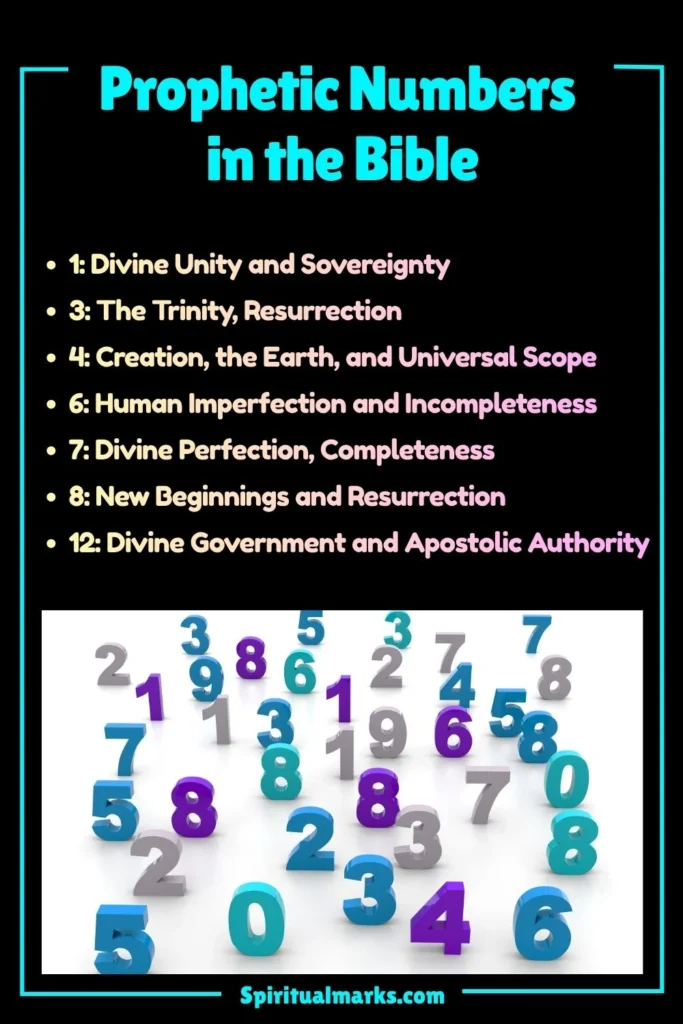
Summary Table: Prophetic Numbers in the Bible at a Glance
| Number | Primary Meaning | Key Scripture References | Prophetic Significance |
|---|---|---|---|
| 1 | Divine unity, new beginnings | Deuteronomy 6:4; John 17:21 | God’s absolute sovereignty; inauguration of new eras |
| 3 | Trinity, divine completeness, resurrection | Matthew 12:40; 1 Corinthians 15:4; John 21:15-17 | Divine validation; fullness of witness |
| 4 | Creation, universal scope | Revelation 7:1; Ezekiel 1:5-10; Daniel 7:3 | Global or cosmic application of God’s purposes |
| 6 | Human imperfection, incompleteness | Genesis 1:31; Revelation 13:18; Exodus 20:9 | Humanity apart from God; always pointing toward seven |
| 7 | Divine perfection, covenant, completeness | Genesis 2:2; Revelation 1:20; Leviticus 25:8 | God’s signature; absolute divine completion |
| 8 | New beginnings, resurrection | Genesis 17:12; 1 Peter 3:20; Matthew 28:1 | New covenant, post-resurrection life |
| 10 | Ordinal completeness, human government | Exodus 34:28 (Ten Commandments); Daniel 7:7 | Full expression of human order and law |
| 12 | Divine government, apostolic authority | Matthew 10:1-4; Revelation 21:12-14; Numbers 1:44 | God’s organized covenant community |
| 40 | Testing, preparation, transition | Matthew 4:2; Numbers 14:33; Genesis 7:12 | Liminal period before divine commissioning |
| 70 | Completeness of governance and judgment | Numbers 11:16; Daniel 9:24; Luke 10:1 | Full scope of human governance under divine oversight |
| 144,000 | Complete sealed remnant | Revelation 7:4; Revelation 14:1 | Total divine protection of God’s covenant people |
| 666 | Human rebellion, beast system | Revelation 13:18 | Maximum human defiance of God; counterfeit completion |
| 1,260 | Tribulation period | Revelation 11:3; Daniel 12:7 | Incomplete, bounded period of opposition to God |
A Final Note
Prophetic numbers in the Bible are not a puzzle to be cracked. They are a language to be learned, lived with, and allowed to deepen your reading of Scripture over time. The more you pay attention to them, the more the entire Bible begins to feel like a single, unified, divinely authored document rather than a collection of ancient texts.
You do not need to be a scholar to appreciate this language. You just need to read Scripture with open eyes and a willing heart. When you notice a number repeating, ask what it might be communicating. When you encounter seven or twelve or forty, recognize that you are standing inside a divine pattern that has been unfolding since the first words of Genesis.
The numbers also serve as an anchor for faith. In a world that often feels chaotic and unordered, the mathematical precision of biblical prophecy is a quiet but powerful reminder that God is not surprised by history. He has numbered the days. He has sealed His people. He has set the times and seasons according to His own authority (Acts 1:7).
If you are new to studying biblical numerology, starting with seven and forty will give you the most immediate and rewarding insight into prophetic patterns. From there, the world of Daniel’s visions, John’s Revelation, and the hidden structures of the Torah will open up in ways that are both intellectually thrilling and spiritually nourishing.
Scripture invites you to “search it out” (Proverbs 25:2). The numbers are waiting for you.