You wake up in the dead of night. A rooster crows. Your heart skips. You glance at the clock. It is 3 am. Something about that sound feels loaded with meaning. You are not imagining it. Across every major civilization, religion, and spiritual tradition, the rooster’s crow has never been treated as ordinary noise. It has always been treated as a signal.
The spiritual meaning of rooster crowing stretches back thousands of years. Ancient Persians believed the rooster was a divine guardian against evil. The Bible uses it as a symbol of human failure and divine truth. In Chinese culture, the rooster announces light defeating darkness. In Celtic tradition, it guards the boundary between worlds.
What makes the rooster so spiritually powerful is its precision. It does not crow randomly. It crows at specific, charged hours of the night and morning. Each of those times carries its own prophetic weight. A crow at midnight means something completely different from a crow at 3 am or dawn. This is not folklore. This is a deeply embedded cross-cultural spiritual language.
This blog post breaks down every significant time and context in which a rooster crows and what each one means for your spiritual life. Whether you are hearing it in waking life, in a dream, or through a sudden memory, the message is specific and worth paying attention to.
Key Takeaways
- The rooster is a universal spiritual sentinel, recognized across Christianity, Islam, Hinduism, Zoroastrianism, and Celtic traditions as a divine messenger and protector against darkness.
- The time of crowing matters deeply. A rooster crowing at midnight, 3 am, or dawn carries distinct spiritual messages that are worth reflecting on seriously.
- Rooster crowing is linked to awakening, both literally and spiritually. It signals transitions, warnings, divine calls to consciousness, and protection from negative energy.
- In the Bible, the rooster’s crow marks one of the most significant moments of human spiritual failure, making it a lasting symbol of accountability and redemption.
- Hearing a rooster crow in a dream carries layered meanings related to truth, warning, personal transformation, and the need to wake up to a reality you may be avoiding.
What Is the Rooster and Why Does It Hold Spiritual Power?
The rooster is not just a farm animal. It is, across almost every human culture that has ever existed, a creature of the threshold. It stands at the border between night and day. It announces the death of darkness and the birth of light. That singular role has made it one of the most spiritually significant animals in the entire natural world.
The rooster’s crow is physiologically precise. Roosters begin crowing several hours before sunrise in response to their internal circadian rhythm. Scientists have confirmed this is not triggered by external light alone. The rooster knows, before any light appears, that the sun is coming. This quality of knowing before seeing is exactly why spiritual traditions have revered it.
Spiritual power belongs to those who sense what others cannot yet perceive. The rooster embodies that quality completely. It does not wait for proof. It announces the dawn while it is still dark. Every major faith and tradition has read into this a divine capacity for warning, prophecy, and protection.
In ancient Persia, the rooster was called “Parodarsh,” the Avesta’s sacred bird. It was believed to crow in response to the divine call of the angel Sraosha, awakening righteous souls to prayer and driving away demons. In Japan, a rooster’s crow lured the sun goddess Amaterasu out of her cave, restoring light to the world. In Greece, the rooster was sacred to Apollo and Asclepius, gods of light and healing.
No other animal holds this consistent cross-cultural role as guardian of the threshold between darkness and light.
What Does Rooster Crowing Symbolize Spiritually?
At its core, the spiritual symbolism of rooster crowing centers on four major themes: awakening, warning, protection, and divine timing.
When a rooster crows, it is not making random noise. It is issuing a declaration. Spiritually, that declaration says: Something is changing. Pay attention. The moment of transition is here. Whether that transition is from night to day, from spiritual sleep to wakefulness, or from danger to safety, the message is always about a shift in conditions.
The rooster is also a symbol of courage and truth. In many traditions, the rooster does not hesitate. It crows even in complete darkness, trusting that the light will come. This mirrors the spiritual call to speak truth and act faithfully even when circumstances offer no visible confirmation.
Vigilance is another core theme. The rooster never sleeps through its duty. It watches through the darkest hours so that others may rest safely. Spiritually, this speaks to the idea of the spiritual warrior or guardian who holds watch over a household, a community, or a soul.
Finally, rooster crowing symbolizes resurrection and renewal. The sun that follows the crow is a daily miracle. Each dawn is a new beginning. Each crow is a reminder that no matter how dark the night has been, the light returns. For anyone walking through grief, difficulty, or spiritual drought, this is a message of profound hope.
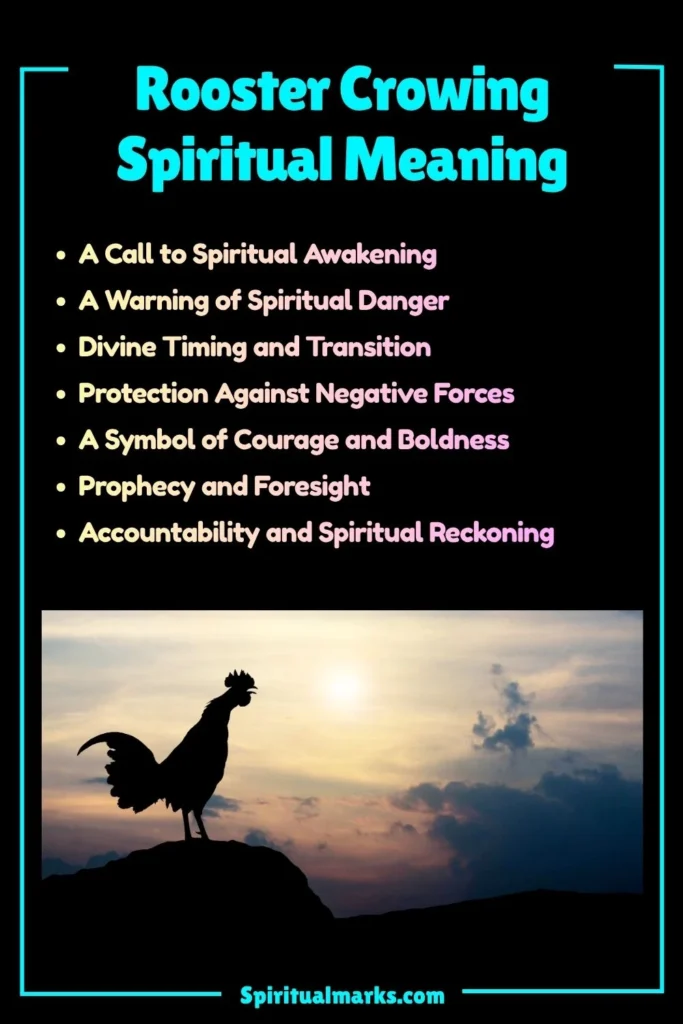
7 Spiritual Meanings of Rooster Crowing
1. A Call to Spiritual Awakening
The most fundamental spiritual meaning of rooster crowing is a call to wake up. Not just physically, but spiritually. Many people move through life in a kind of spiritual sleep, numbed by routine, distraction, or unresolved pain. When a rooster crows in an unusual moment or at an unexpected hour, many traditions read this as a direct divine prompt to wake up to your purpose, your truth, or a situation you have been avoiding.
This awakening is not aggressive. It is urgent, but it is also compassionate. The rooster does not shatter the night; it announces the morning. The invitation is to rise with the same grace and intentionality. You are being called to step into greater consciousness, clearer purpose, and more deliberate spiritual living.
In many Indigenous traditions across Africa and the Americas, unexpected or repeated rooster crowing near a home is treated as a divine invitation to prayer, meditation, or ceremony. The sound is read as a knock on the door of the soul. Your response to that knock is entirely up to you.
The call to awakening also applies to relationships. If a rooster crows repeatedly during a significant moment in your personal life, some spiritual frameworks interpret this as a signal to wake up to a relational truth. Something important may need your full, conscious attention.
2. A Warning of Spiritual Danger
Across West African spiritual traditions, particularly in Yoruba and Akan cultures, a rooster crowing at unusual times signals the presence of spiritual danger. This does not necessarily mean immediate physical harm. It may mean that negative energy, ill intention from another person, or a spiritually unsafe environment has entered your proximity.
The rooster is understood in these traditions as a creature that can sense what human eyes cannot. Its crow in these moments is a protective alarm. Experienced spiritual practitioners in these communities take such crows seriously. They may follow the crow with prayer, protective rituals, or a careful examination of their current circumstances and relationships.
This warning function is also present in European folk traditions. In many parts of rural France, Germany, and Eastern Europe, a rooster crowing toward a house rather than the sky was historically interpreted as a warning of illness, misfortune, or the approach of unwanted spiritual energy. The direction of the crow mattered as much as the timing.
Take any unexpected, unseasonal, or middle-of-the-night crow as a prompt to evaluate your spiritual boundaries. Who have you recently let into your life? What situations have you been exposed to? The rooster is not creating fear. It is offering you the gift of early awareness.
3. Divine Timing and Transition
The rooster is perhaps nature’s most precise timekeeper. This is why its spiritual meaning so deeply involves divine timing. When a rooster crows, it marks a moment of transition. That transition may be literal, from night to morning, or it may be metaphorical, from one season of your life to another.
In Zoroastrian teaching, the rooster’s midnight crow marks the moment when divine forces of light begin reclaiming ground from forces of darkness. The crow does not wait for the battle to be won. It announces the turn of the tide before the outcome is visible. This is a profound spiritual metaphor for trust.
Many people experience a rooster crowing during a major life decision, a grief process, or a significant spiritual crossroads. In these moments, the crow functions as a divine timestamp. It is as if the universe is saying: This is the moment. The turn has begun. Trust the process.
If you are in transition right now, and a rooster crows near you, consider it an affirmation. The timing is right. The shift has already begun, even if you cannot yet see the light breaking through.
4. Protection Against Negative Forces
In virtually every ancient tradition, the rooster is a guardian against darkness. This protection operates on both physical and spiritual planes. The ancient Persians placed rooster imagery on their homes and temples to repel demons. Zoroastrian texts explicitly describe the rooster’s crow as the sound that drives away daevas, evil supernatural entities.
In Chinese feng shui, a rooster image at the front of a home is a powerful protective symbol. It specifically wards off “sha qi,” meaning negative or killing energy. The rooster faces the source of negativity without fear and sounds its crow as both alarm and weapon.
In medieval European Christian tradition, the rooster was placed atop church steeples for this exact reason. It was not purely decorative. It was a spiritual sentinel, facing the wind, always vigilant, always crowing against the forces of spiritual darkness.
When you hear a rooster crow near your home, especially at unusual hours, one valid spiritual reading is that it is doing its ancient job: protecting your space. Rather than fear, the appropriate response in many traditions is gratitude and attentiveness. The guardian is on duty.
5. A Symbol of Courage and Boldness
The rooster does not whisper. It does not wait for permission. It stands in complete darkness, opens its chest, and declares with full voice that the light is coming. This is one of the most powerful spiritual invitations in nature: to be courageous before you have proof.
Many spiritual traditions directly link the rooster’s crow to the theme of bold, truth-telling courage. In cultures across Southeast Asia, the rooster is depicted in sacred art as a warrior bird, representing the courage to speak truth at great personal cost. The rooster crows even if predators are near. It crows even if it is alone.
This courage symbolism is particularly relevant if you are facing a situation where speaking truth feels dangerous or costly. The rooster’s crow may be the universe’s way of reminding you that speaking up is your sacred responsibility. You do not need to wait until the environment is safe. The light follows the crow, not the other way around.
The rooster also teaches spiritual boldness in identity. It does not hide what it is. It announces itself loudly and without apology. This is a call to stop dimming your spiritual light to make others comfortable.
6. Prophecy and Foresight
The rooster’s ability to announce the dawn before it arrives has made it a symbol of prophecy and spiritual foresightacross nearly every tradition. The prophet, the seer, and the spiritual leader have always been compared to the rooster because they speak of what is coming before others can see it.
In ancient Greece, the rooster was sacred to the Oracle tradition. Before entering the oracle at Delphi, worshippers would offer a rooster as a gift, asking for the clarity of foresight. The connection between the rooster and prophetic vision was explicit and taken seriously.
If you are someone who receives intuitive impressions, dreams, or spiritual downloads, a rooster crowing near you can be interpreted as a validation of your prophetic sensitivity. Your ability to sense what is coming is not imagination. The rooster is your spiritual kin.
Pay attention in the hours immediately following an unusual rooster crow. Many people report that the period after such a crow brings unexpected clarity, insight, or the sudden understanding of a situation that previously felt confusing.
7. Accountability and Spiritual Reckoning
Perhaps the most sobering spiritual meaning of rooster crowing comes from its role in one of the most significant moments in the New Testament. When Peter denied Jesus three times before the rooster crowed, the crow became a symbol of accountability and spiritual reckoning. The sound broke Peter’s self-deception. He could no longer pretend he had not failed.
This meaning resonates deeply beyond its biblical context. A rooster crow can function as a spiritual mirror. It forces you to see yourself as you truly are, not as you wish to appear or as you have been telling yourself you are. This is uncomfortable. It is also profoundly liberating.
In many spiritual practices worldwide, the rooster crow at dawn is the moment when the mask drops. The night allowed illusion. The dawn demands truth. If you are carrying a secret, a self-deception, or a burden of unaddressed guilt, the spiritual meaning of that crow is an invitation to release it.
Accountability, in spiritual terms, is not punishment. It is the gateway to redemption. Peter’s story did not end with the crow. It ended with restoration and purpose. The crow is never the last word. It is always the beginning of something more honest and more whole.
Rooster Crowing at Different Times: Spiritual Meanings by the Hour
Rooster Crowing at Night (General)
A rooster crowing at night is considered one of the most spiritually significant occurrences across traditions worldwide. Roosters are not supposed to crow in the dark of night without cause. Their natural rhythm ties them to light. When they crow in complete darkness, experienced spiritual practitioners across cultures take notice.
In many West African traditions, a nighttime crow signals that a spirit is passing nearby. The rooster senses what human senses cannot. Its crow is both a warning and an acknowledgment of that unseen presence. This is not inherently negative. Spirits of ancestors or divine messengers may be moving through your space.
In Caribbean Vodou and Candomblé traditions in Brazil, a rooster crowing at night near a ritual space is interpreted as a sign that the spirits called upon have arrived. The rooster acts as a spiritual doorman, announcing the presence of the divine.
If a rooster crows at night near your home, pause. Pray, meditate, or simply become still. Something in the spiritual atmosphere is in motion. Your awareness is the appropriate response.
Rooster Crowing at Midnight
Midnight rooster crowing holds a reputation as one of the most charged spiritual signals in folklore and religious tradition. Midnight is the precise midpoint of darkness. It is the moment farthest from both the previous dawn and the coming one. Spiritually, it represents the deepest point of a trial, a confusion, or a spiritual night.
In Zoroastrian tradition, midnight is when the battle between light and darkness reaches its most intense point. A rooster crowing at exactly midnight was understood as a divine intervention, a declaration that light had not surrendered and would not.
In European folk tradition, a midnight crow was interpreted as a sign of supernatural activity nearby. It was not necessarily malevolent, but it was always significant. People would pray, cross themselves, or recite protective prayers in response.
If you hear a rooster crow at midnight, the spiritual message is one of steadfastness. You may be in the deepest part of your night, your hardest season, your longest trial. The crow at midnight says: hold. The light has not forgotten you. You are not as alone as you feel.
Rooster Crowing at 1 AM
A rooster crowing at 1 am is spiritually linked to restlessness of the soul. One in the morning is the first hour past midnight, the point where the body naturally wants sleep and the mind begins to surface unresolved thoughts. A crow at this hour is often interpreted as a prompt to examine what is keeping your spirit unsettled.
Many spiritual traditions associate this hour with the activity of ancestors or spirit guides who are trying to get your attention. If you wake at 1 am to the sound of a rooster crow, consider sitting quietly for a few minutes. Breathe. Listen to your own thoughts. What is the first thing that comes to mind? That thought may carry the message the crow was pointing you toward.
In some folk magic traditions of Latin America, a rooster crowing at 1 am near a grieving household is interpreted as a visit from the recently departed. The spirit is not trapped or suffering. It is communicating. The crow is its voice borrowed through the animal’s sensitivity.
Write down what you feel and think immediately after such a crow. The intuitive impressions that surface in this window of time are often more spiritually accurate than those that come during busy daylight hours.
Rooster Crowing at 2 AM
The 2 am hour carries deep spiritual significance in many traditions. It is often called the “witching hour” in European tradition, the time when the veil between the physical world and the spiritual world is at its thinnest. A rooster crowing at 2 am is a powerful signal.
In some Native American traditions, 2 am is when spirit communication is most accessible. Animals that vocalize at this hour are doing so because they sense something significant in the unseen world. The rooster’s crow at 2 am is a bridge between worlds.
For those experiencing grief, hearing a rooster at 2 am is often interpreted as contact from a loved one who has passed. The specific message varies, but the emotional quality is almost always one of reassurance. The soul of the departed is not gone. It is simply elsewhere.
On a more cautionary note, if you feel fear or unease when you hear the 2 am crow, take that seriously. Your instincts are tuned to pick up on the quality of the spiritual energy present. Protective prayer, visualization of light, or the burning of sage or frankincense are all traditional responses to a 2 am spiritual signal that feels heavy rather than peaceful.
Rooster Crowing at 3 AM
The 3 am hour is the most spiritually loaded of all nighttime hours in global tradition. Called the “devil’s hour” in Christian folk tradition, this is the hour that many spiritual practitioners consider the most spiritually active of the entire night. A rooster crowing at 3 am is taken with the utmost seriousness.
In Christian tradition, 3 am is considered a counterfeit of the 3 pm hour, when Christ died on the cross. Spiritual warfare in Christian prayer circles is often understood to be most intense at this time. A rooster crowing at 3 am is sometimes interpreted as a divine alarm, calling the spiritually attuned to prayer specifically because the spiritual atmosphere is charged.
Many people across cultures report waking spontaneously at 3 am as part of their spiritual development. If this is coupled with a rooster’s crow, the message is particularly direct: you are being called to intercession, prayer, or spiritual vigilance on behalf of yourself or someone in your life.
In Islamic tradition, the last third of the night is considered the most blessed time for prayer. 3 am falls within this window. A rooster crowing at this hour is understood as a divine prompt to rise for Tahajjud, the voluntary night prayer, one of the most spiritually powerful practices in Islamic devotion.
Do not dismiss a 3 am crow as coincidence. Whatever your tradition, this is an hour that demands spiritual attention rather than spiritual sleep.
Rooster Crowing at 4 AM
4 am crowing sits at the threshold between deep spiritual night and the first preparations for dawn. Many spiritual traditions associate this hour with preparation, readiness, and the beginning of divine action. The darkness is still complete, but the rooster knows what is coming. It prepares.
In many monastic traditions across Christianity, Buddhism, and Hinduism, the 4 am hour is the sacred hour of morning prayer and meditation. Monks and nuns rise at this hour specifically because it is spiritually potent. A rooster crowing at 4 am is understood as a confirmation that this is sacred time, not to be wasted in sleep.
For ordinary people, a 4 am crow carries the message of readiness. Something is coming in your life. It may be an opportunity, a challenge, or a transition. The crow is a prompt to prepare yourself spiritually, mentally, and practically. The person who is awake and ready when the opportunity arrives is the person who will walk through the door.
In some African traditional religions, 4 am is when the prayers of the ancestors are most easily heard. A rooster crowing at this hour near a home is a signal that ancestral support and protection are actively working on behalf of that household.
Rooster Crowing at 5 AM
5 am is the hour of first light’s approach. The rooster’s crow at this hour is its most natural and expected call, yet even here, the spiritual meaning is rich. This crow is the declaration of victory. The night has passed. The light is genuinely coming. Whatever darkness you faced through the night, you made it through.
In many spiritual traditions, the 5 am crow represents the answer to midnight prayers. You cried out in darkness. You held on through the 3 am hour. You prepared at 4 am. And now, at 5 am, the answer comes. The crow is the announcement that the season of waiting is ending.
In traditional Chinese spiritual practice, 5 am corresponds to the “Mao” hour in the Chinese astrological clock, associated with the rabbit, new beginnings, and the emergence of positive energy. A rooster crowing at this time is deeply auspicious, signaling that fresh energy, new opportunities, and positive transitions are entering your life.
For those who have been through prolonged seasons of difficulty, the 5 am crow is a message of profound hope. Your dawn is not theoretical. It is arriving right now. Receive it with gratitude.
Rooster Crowing in the Morning
Morning crowing is the rooster’s most recognized spiritual act. As the sun rises, the rooster’s crow has been interpreted for millennia as a declaration of new beginnings, fresh grace, and the renewal of divine favor. Each morning that begins with a rooster’s crow is a spiritual reminder that you have been given another day, another chance, another measure of grace.
In Hinduism, the morning crow of the rooster aligns with the sacred concept of Brahma Muhurta, the creator’s hour, occurring approximately 90 minutes before sunrise. This is considered the single most spiritually potent window of the day for prayer, yoga, and meditation. The rooster’s crow within this window is understood as an invitation to participate in this sacred time.
The morning crow also speaks to purpose and calling. Just as the rooster fulfills its specific function each morning without fail, you are being reminded of your own calling. What is your specific contribution to the day? What is your irreplaceable role? The morning crow calls you to show up fully in that identity.
In many cultures, a rooster crowing as you step outside in the morning is considered an auspicious omen for the day’s endeavors. It signals clear energy, divine favor, and the presence of protective spiritual forces accompanying your activities.
Rooster Crowing at Noon
A rooster crowing at noon is unusual enough to be spiritually notable. Noon is the peak of daytime, the sun’s fullest height, and the point of maximum light. A crow at noon is interpreted in many traditions as a signal to pause at the height of your activity and realign with your spiritual center.
In Christian contemplative tradition, noon is historically a sacred prayer hour. The “noonday prayer” or “Sext” in the canonical hours marks this midpoint of the day as sacred. A rooster crowing at noon in this context is a prompt to step away from the busyness of the day and return to the center.
In some folk traditions, a noon crow is interpreted as a warning against overconfidence. You are at the height of your day, your project, your season of success. The crow reminds you to stay humble, stay spiritually grounded, and not mistake the height of noon for the permanence of success. The sun at noon is also beginning its descent.
Pay attention to what you are doing or thinking about when you hear a noon crow. The subject of your mind in that moment may be precisely what the spiritual message is addressing.
Rooster Crowing in the Evening
A rooster crowing at evening is considered spiritually unusual in most traditions. The natural order calls for roosters to crow at dawn, not at dusk. An evening crow therefore carries the weight of being a counter-sign, a signal that something in the natural or spiritual order requires attention.
In many European folk traditions, an evening crow was interpreted as an omen of change. The day is ending, and something significant is shifting with it. This is not necessarily negative change. It may signal the end of a difficult chapter and the beginning of something better.
In African traditional spiritual systems, an evening crow near a household is a prompt to examine the spiritual atmosphere of the home before the night begins. The rooster is signaling that something needs clearing or protection before darkness falls. Evening prayers, gratitude rituals, or protective practices are the traditional responses.
On a personal level, if you hear a rooster crow as evening falls, consider it an invitation to reflect on the day honestly. What did you do well? What would you do differently? Where did you miss the spiritual mark? The evening crow is a daily checkpoint before the rest of night.
Rooster Crowing During the Daytime
Daytime crowing outside of the morning hours is spiritually interpreted across many traditions as a sign of urgency. The rooster is not following its natural pattern. Something has prompted it to speak when it would otherwise be quiet. That unusual quality is itself the message.
In many Latin American curanderismo traditions, a rooster crowing unprompted in the middle of the day is understood as a spiritual alert that something in the energetic environment of the home has shifted. It may indicate that a visitor’s energy was unwelcome, that a spiritual protection is wearing thin, or that prayer and cleansing are needed.
In rural Southeast Asia, a daytime crow is sometimes interpreted as the announcement of an approaching visitor, particularly one whose arrival will be significant. The crow functions as a spiritual advance notice, giving the household time to prepare spiritually and practically.
Whatever the tradition, unexpected daytime crowing deserves thoughtful attention. It is not normal behavior for the rooster, and that abnormality carries spiritual meaning. Pause. Reflect. Consider what in your immediate environment or life situation may be calling for spiritual attention.
Rooster Crowing Symbolism Across Cultures and Religions
The rooster’s crow carries spiritual weight on every inhabited continent. Its role as a spiritual guardian and messenger has been independently developed by cultures with no contact with each other, which speaks to something deeply universal in the rooster’s spiritual function.
In ancient Persia, the Zoroastrian sacred text, the Avesta, describes the rooster as the divinely appointed herald of the angel Sraosha. This rooster, called “Parodarsh” or the far-seeing one, crows three times during the night. Each crow marks a sacred threshold moment, calling the righteous to prayer and driving evil spirits from the world.
In ancient Greece and Rome, the rooster was sacred to Helios, the sun god, and later to Apollo. It was also closely associated with Asclepius, the god of healing, which is why Socrates’s final words included a request to offer a rooster to Asclepius. The rooster’s crow was understood as healing the world of darkness each morning.
In Chinese culture, the rooster holds a place in the twelve animal zodiac. The crow of the rooster is associated with good luck, honesty, and the dispersal of evil spirits. Red roosters, in particular, are protective symbols, and their crow at dawn is understood as the daily defeat of yin energy by yang energy.
In Japanese Shinto mythology, it was the crow of a rooster that lured the sun goddess Amaterasu from her cave. In her absence, the world had fallen into darkness and chaos. The rooster’s crow restored divine light to the world, cementing its role as a sacred restorer of cosmic order.
In Islamic tradition, the rooster holds a remarkable place. The Prophet Muhammad, peace be upon him, explicitly stated in a Hadith recorded in Sahih Bukhari that when you hear a rooster crowing, ask Allah for His bounty, for the rooster has seen an angel. This is not metaphorical in Islamic understanding. The rooster’s crow is treated as a literal signal of angelic presence.
In Celtic tradition, the rooster was a creature of the Otherworld. It stood at the boundary between the living and the dead. A crow from a Celtic rooster was not unusual noise; it was a voice from the threshold between worlds, carrying messages and warnings from beyond the visible.
Rooster Crowing in the Bible: Biblical Meaning and Significance
The rooster in the Bible holds one of the most dramatic and spiritually significant roles of any animal in scripture.Its crow marks the precise moment of Peter’s betrayal of Christ, recorded in all four Gospels: Matthew 26:74-75, Mark 14:72, Luke 22:60-61, and John 18:27.
Jesus had warned Peter that he would deny him three times before the rooster crowed. Peter was confident in his loyalty. He was wrong. When the rooster crowed after his third denial, Peter remembered Christ’s words and wept bitterly. That crow was not just a sound. It was a divine judgment, a moment of holy accountability delivered through the animal that stands at the boundary between night and day.
The biblical rooster’s crow represents the confrontation between human self-confidence and spiritual truth. Peter believed he was strong enough not to fail. The rooster proved otherwise. This is a universal human experience, that moment when our self-image cracks and we see ourselves as we truly are.
But the biblical story of Peter does not end in shame. After the resurrection, Jesus specifically restored Peter three times, once for each denial. The rooster’s crow was not the end of Peter’s story. It was the beginning of his honest one. Without that crow, without that shattering of self-deception, the Peter who became the rock of the early church might never have emerged.
Mark 13:35 uses the rooster crow as a metaphor for one of the four watches of the night. Jesus tells his disciples to stay awake and watch, for the master could return “in the evening, or at midnight, or at the cock-crowing, or in the morning.” The rooster’s crow here is explicitly used as a sacred division of time, a spiritual threshold moment within the Christian eschatological framework.
The rooster also appears symbolically in the book of Job (38:36), where God asks Job, “Who has put wisdom in the inward parts? Or who has given understanding to the mind?” Some translations render the Hebrew “Sekwi” as rooster, associating the rooster with divine wisdom and understanding.
Rooster Crowing in World Mythologies
Mythology across every culture uses the rooster’s crow as a cosmic reset button, the moment when the forces of chaos, darkness, and death are pushed back by order, light, and life.
In Norse mythology, a golden rooster named Gullinkambi sits in the branches of Yggdrasil, the world tree. Its crow will wake the gods and heroes at the beginning of Ragnarok, the end of days. A second unnamed rooster crows in the realm of the dead, and a third, Fjalarr, crows in the world of giants. All three mark cosmic transitions, points of no return in the unfolding of divine history.
In Hindu mythology, the rooster is associated with Kartikeya, the god of war and victory. Kartikeya’s divine vehicle, or vahana, is the rooster, called “Krunja.” This association links the rooster’s crow to divine victory, the triumph of good over evil, and the protection of the righteous in battle.
In Chinese mythology, the Jade Rooster in the celestial palace crows first each morning. All earthly roosters hear its crow and echo it down through the world. The earthly crow is thus understood as a relay of divine sound, a sacred transmission from the heavens to the physical world.
In ancient Egyptian belief, the rooster was connected to the sun god Ra’s daily journey. As Ra traveled through the underworld during the night, the rooster’s crow at dawn marked his victorious return to the sky. The crow was proof that Ra had defeated Apophis, the serpent of chaos, once again.
In Zoroastrian cosmology, the rooster is not just a bird; it is a spiritual soldier in the cosmic army of Ahura Mazda, the supreme god of good. Its crow at the three sacred night hours is an active spiritual act, not passive noise. The rooster fights darkness with its voice.
Rooster Crowing and Dreams: Spiritual and Psychological Meanings
Dreaming of a rooster crowing is one of the more vivid and spiritually charged dream experiences. The details of the dream matter enormously. When the crow comes, how it sounds, and how you feel in response all shape the interpretation.
A rooster crowing loudly and confidently in a dream is widely interpreted as a signal that your waking life is calling for boldness. Something you have been putting off, a conversation, a decision, a leap of faith, is overdue. The dream rooster is telling you that the time for hesitation has ended. Speak. Act. Declare.
A rooster crowing in darkness within a dream carries the sense of a prophetic message. You may be receiving insight about something in your waking life that has not yet been revealed to others. Your intuition is ahead of the visible facts. Trust it. The crow in the dark is always the precursor to light, never the companion of permanent darkness.
A red rooster crowing in a dream is associated across many traditions with passion, urgency, and sometimes temptation or warning. The color red amplifies the emotional intensity of the crow’s message. Ask yourself: what in your waking life is generating the most intense emotional energy? The dream is likely addressing that directly.
A silent rooster in a dream, one that opens its beak to crow but produces no sound, is psychologically and spiritually significant. It may point to feelings of being unheard, of having important things to say that no one is receiving. It may also signal that you are suppressing your truth in a way that is spiritually costly.
Psychologically, Carl Jung’s work on animal archetypes supports the reading of dream roosters as symbols of the ego’s confrontation with the unconscious. The crow breaks through the silence of the night mind and forces the sleeper to engage with what is being repressed or ignored. The rooster in Jungian terms is the self-assertion of the psyche’s need to be seen and heard.
Summary Table: Rooster Crowing Spiritual Meaning at a Glance
| Time / Context | Spiritual Meaning |
|---|---|
| At Night (General) | Spirit presence nearby, supernatural awareness, call to prayer |
| At Midnight | Deepest trial, divine steadfastness, light has not surrendered |
| At 1 AM | Soul restlessness, ancestral communication, examine unresolved issues |
| At 2 AM | Thinning veil, contact from the departed, ancestral reassurance |
| At 3 AM | Spiritual warfare, divine call to intercession and prayer, sacred watchfulness |
| At 4 AM | Preparation, readiness, ancestral protection actively working |
| At 5 AM | Victory of light, answers to prayer arriving, new positive energy |
| Morning | New beginnings, fresh grace, divine calling confirmed |
| Noon | Pause and realign, warning against overconfidence, spiritual checkpoint |
| Evening | Counter-sign, change approaching, clear and protect before nightfall |
| Daytime | Urgency, energetic shift in environment, unexpected spiritual alert |
| In Dreams | Bold action needed, prophetic insight, suppressed truth demanding voice |
| In the Bible | Accountability, confrontation with self-deception, gateway to redemption |
| In Islam | Angel is present, ask for divine bounty, sacred signal |
| In Chinese Tradition | Relay of divine sound, auspicious energy, protection and good fortune |
| In Zoroastrian Tradition | Active spiritual soldier, drives away evil, marks sacred night thresholds |
| Red Rooster | Urgency, passion, temptation or warning requiring immediate attention |
| Rooster General Symbolism | Awakening, warning, protection, divine timing, courage, prophecy, accountability |
A Final Note
The rooster’s crow has never been just a sound. For every culture that has ever lived close to the land, close to the spiritual world, and close to the mysteries of night and day, it has been a voice. A real, specific, spiritually loaded voice.
Whether you are hearing it at 3 am and feeling a pull toward prayer, or waking at 5 am to a crow that feels like an answer to something you asked in the dark, pay attention. The spiritual meaning of rooster crowing is not a relic of superstitious tradition. It is a living symbolic language that your soul already understands.
You do not have to belong to any particular tradition to receive the rooster’s message. The rooster speaks to the human spirit directly. Its themes are universal: wake up, pay attention, be brave, speak your truth, trust the light, and know that the dawn is coming.
The next time a rooster crows in your world, pause before dismissing it. Ask yourself what time it is, not just on the clock, but in your life. Ask what season you are in. Ask what has been left unsaid, what has been left undone, what truth has been left unacknowledged. The answer that surfaces in that quiet moment after the crow? That is the message you were meant to receive.