You’re walking along, mind busy with everyday thoughts, and then something small catches your eye. A feather. It lies quietly on your path, almost as if it waited for you. Moments like this feel ordinary at first, yet many people sense something deeper beneath them. Why this feather? Why now?
That quiet question is where the meaning begins. Across cultures, belief systems, and spiritual traditions, feathers carry layered symbolism that reaches far beyond their physical form. Some people feel comfort when they see one. Others pause, unsettled, as if something unseen just brushed against their awareness. Either reaction matters.
This blog post approaches the spiritual meaning of feathers with depth and clarity. Instead of offering a single interpretation, it opens space for multiple perspectives shaped by history, culture, and personal experience. As you read, you may notice certain meanings resonate more strongly than others. That is not accidental. Symbolism tends to meet us where we are.
Key Takeaways
- Feathers often symbolize spiritual connection, particularly messages from higher realms, ancestors, or unseen guidance.
- Their meaning depends heavily on context, including where you find them, your emotional state, and recurring patterns.
- Different cultures assign unique meanings, yet most share themes of protection, truth, and transformation.
- Seeing multiple feathers can intensify the message, suggesting urgency, alignment, or reinforcement.
- Personal intuition plays a major role, since symbolic experiences rarely carry one fixed interpretation.
What Do Feathers Symbolize Metaphysically?
At a deeper level, feathers represent connection. Not in a simple or decorative way, but as a bridge between two very different realms. Birds live in the sky, moving through a space humans can see but never fully inhabit. Because of this, feathers often become symbols of communication between the physical world and something beyond it.
This idea shows up repeatedly across metaphysical traditions. Feathers are associated with lightness, not only in weight but in emotional and spiritual terms. When people speak about feeling “lighter,” they often mean releasing burdens, gaining clarity, or stepping away from confusion. A feather mirrors that state. It carries almost no resistance. It moves with the wind rather than against it.
At the same time, feathers connect to truth and awareness. In several belief systems, truth is not loud or forceful. It arrives quietly, often in moments when you least expect it. A feather appearing in your path can reflect that same quiet presence. It does not demand attention, yet it invites it.
Another layer emerges through the idea of protection. Many people interpret feathers as subtle signs that they are not alone, especially during uncertain or emotionally heavy periods. This does not rely on a single religious framework. Instead, it reflects a shared human instinct to look for reassurance when life feels unstable.
There is also the theme of movement and messages. Birds travel freely across distances that humans cannot easily cross. Because of that, feathers often symbolize messages carried from one place or state of being to another. When you find one unexpectedly, it can feel like a pause inserted into your routine, almost as if something asked you to stop and notice.
10 Spiritual Meanings of Finding Feather
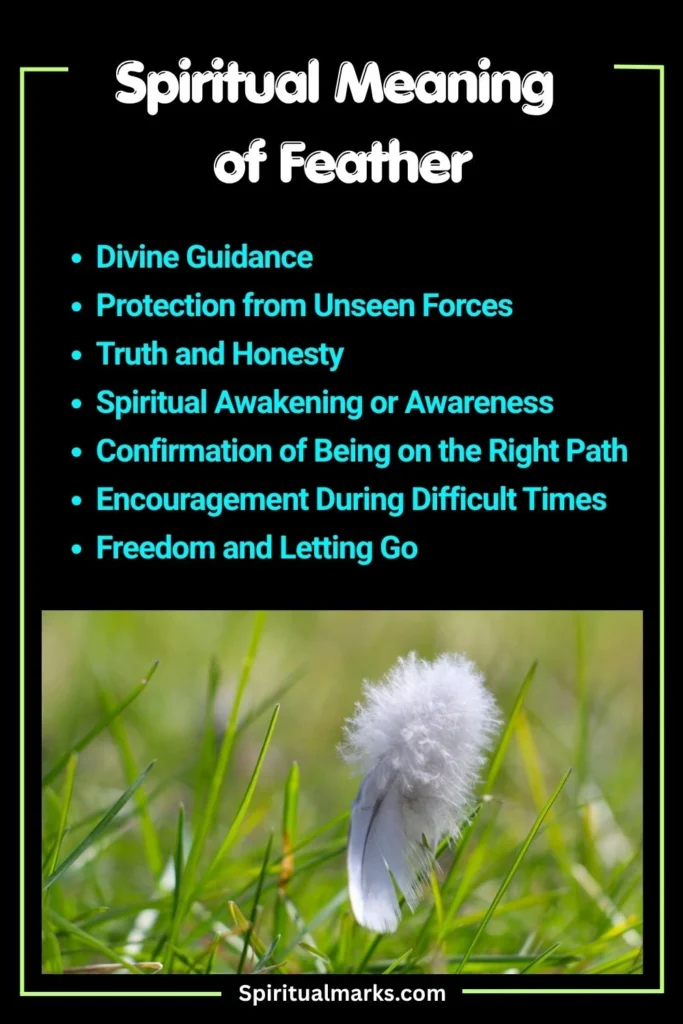
1. Divine Guidance
At certain points in life, direction feels unclear. Decisions stack up, and even small choices carry weight. In these moments, many interpret a feather as a subtle form of guidance, a signal that you are not navigating life alone.
In spiritual traditions that acknowledge higher forces, whether framed as God, the universe, or spirit guides, feathers often appear as symbolic messages. They do not provide direct answers. Instead, they reinforce trust. You are moving, and something greater is aware of that movement.
This idea appears in both ancient and modern interpretations. Indigenous belief systems often see feathers as sacred objects connected to spiritual communication, while contemporary spirituality frames them as signs of alignment. The common thread is reassurance.
What makes this meaning compelling is timing. People rarely notice feathers during neutral moments. They tend to appear when you are questioning, hesitating, or searching. That context shapes the interpretation. The feather becomes less about the object itself and more about what is happening within you when you find it.
2. Protection from Unseen Forces
There are phases in life when vulnerability feels heightened. You might be dealing with uncertainty, emotional strain, or external challenges that seem difficult to control. During such periods, finding a feather often takes on a protective meaning.
In Christian symbolism, feathers connect closely with angels and divine shelter. Biblical imagery frequently describes being covered or shielded under wings, suggesting safety in the presence of a higher power. This association carried forward into modern interpretations, where feathers represent spiritual guardianship.
Beyond Christianity, many cultures share similar ideas. Feathers appear in protective rituals, ceremonial clothing, and sacred objects. They act as symbols of watchfulness, not in a fearful sense, but in a reassuring one.
When people encounter a feather during a stressful time, they often describe a shift in feeling. Not a complete removal of fear, but a softening. A sense that something stands between them and harm. Whether interpreted literally or symbolically, the message centers on safety.
3. Connection with a Loved One Who Has Passed
Grief creates a unique kind of awareness. Small signs begin to feel meaningful because they interrupt absence. Among these signs, feathers hold a particularly strong emotional connection for many people.
The idea that a feather represents communication from someone who has passed is common in modern spiritual belief. It suggests continuity rather than finality. The relationship changes form, but it does not disappear entirely.
White feathers, in particular, have become widely associated with this meaning. They are often interpreted as gentle reminders that a loved one remains present in some way, offering comfort rather than direct interaction.
Skeptics may view this as coincidence. Others see it as emotional projection. Yet for those experiencing loss, the interpretation serves a different purpose. It provides a moment of closeness in a space that often feels empty.
What matters here is not proof, but impact. The feather becomes a symbol of ongoing connection, helping individuals process grief while maintaining a sense of emotional continuity.
4. Spiritual Awakening or Awareness
There are periods when perception begins to shift. You start noticing patterns, questioning old beliefs, or feeling drawn to deeper reflection. These phases are often described as spiritual awakening, and feathers frequently appear during such transitions.
In this context, the feather symbolizes sensitivity. Not weakness, but openness. You become more aware of subtle experiences, whether emotional, intuitive, or symbolic.
Many spiritual teachings describe awakening as a gradual process rather than a sudden event. Feathers fit naturally into this idea. They are quiet signals, not dramatic revelations. Their presence encourages observation rather than reaction.
At the same time, this meaning does not require belief in the supernatural. From a psychological perspective, noticing a feather during a reflective phase can reinforce your internal state. It acts as an external marker of something already happening within you.
Either way, the interpretation remains consistent. The feather points toward growth in awareness, suggesting that your perspective is expanding.
5. Confirmation of Being on the Right Path
Few experiences feel as uncertain as making a major decision. Even when logic supports your choice, doubt often lingers. This is where symbolic confirmation becomes meaningful.
Many people interpret finding a feather as a form of validation. A quiet “yes” that affirms your direction. This belief appears across various spiritual frameworks, where signs are seen as alignment between personal intention and a broader flow.
The timing again plays a crucial role. Feathers that appear during decision-making moments tend to carry more weight. They intersect directly with your thoughts, which makes the interpretation feel personal.
However, this meaning does not eliminate uncertainty. Instead, it softens it. It encourages trust without demanding certainty. You still move forward, but with a sense that your path holds coherence.
From a broader perspective, this interpretation reflects a human need for reassurance. Whether the source is spiritual or psychological, the effect remains the same. You feel steadier in your choices.
6. Encouragement During Difficult Times
Hard periods often narrow focus. Challenges dominate attention, making it difficult to see beyond immediate struggles. In these moments, even small symbols can carry emotional weight.
A feather found during hardship often represents encouragement. Not in a loud or forceful way, but in a quiet, steady manner. It suggests that the current situation is temporary, even if it feels overwhelming.
Spiritual interpretations frequently describe feathers as reminders of resilience. They appear not to solve problems, but to reinforce endurance. You are still here. You are still moving.
Interestingly, this meaning overlaps with emotional coping mechanisms. Humans naturally seek signs of hope during difficult times. A feather can fulfill that role, offering a momentary shift in perspective.
This does not diminish its significance. If anything, it highlights how deeply symbolic objects can influence emotional states. The feather becomes a point of pause, allowing you to regain balance before continuing forward.
7. Freedom and Letting Go
Feathers exist because of flight. They are shaped by movement, by the ability to rise above ground. This physical quality directly influences their symbolic meaning.
In many traditions, feathers represent freedom. Not only physical freedom, but emotional and psychological release. Letting go of what weighs you down becomes the central theme.
This interpretation often appears during times of transition. Ending a relationship, changing careers, or releasing long-held beliefs. The feather signals lightness, suggesting that holding on may no longer serve you.
Cultural symbolism reinforces this idea. Birds have long represented transcendence, and feathers carry that symbolism in a more accessible form. You do not need to see the bird. The feather itself becomes enough.
At the same time, letting go is rarely simple. It involves uncertainty and sometimes loss. The feather does not deny that complexity. Instead, it acknowledges it while pointing toward possibility.
8. Truth and Honesty
In ancient Egyptian belief, the feather held a profound role in the concept of truth. The feather of Ma’at symbolized balance, justice, and moral clarity. It was used metaphorically in the weighing of the soul, where truth determined spiritual outcome.
This historical context gives feathers a deeper layer of meaning. They are not only gentle or comforting symbols. They can also represent accountability and integrity.
When interpreted this way, finding a feather may prompt reflection. Are you being honest with yourself? Are your actions aligned with your values? These questions emerge naturally within this framework.
Unlike other meanings, this one carries a slightly heavier tone. It is less about reassurance and more about clarity. Yet even here, the feather remains a balanced symbol. It encourages truth without harsh judgment.
This duality makes the interpretation particularly meaningful. It combines lightness with depth, reminding you that honesty can bring both challenge and relief.
9. Transformation and Personal Growth
Change rarely announces itself clearly. It unfolds gradually, often through discomfort or uncertainty. Feathers, in many interpretations, symbolize this process of transformation.
Birds shed and regrow feathers as part of their natural cycle. This biological reality reinforces the symbolic meaning of renewal. Growth involves both loss and regeneration.
In spiritual writing, feathers often appear during periods of personal evolution. You may be moving away from an old identity or stepping into a new role. The feather reflects that transition.
This meaning resonates because it aligns with lived experience. Growth is rarely linear. It includes setbacks, adjustments, and moments of doubt. The feather does not simplify that journey. Instead, it mirrors its complexity.
From another angle, transformation also involves perception. You begin to see yourself differently. The feather becomes a marker of that shift, signaling that change is already in motion.
10. Reminder to Stay Light and Balanced
Life has a way of accumulating weight. Responsibilities, expectations, and emotions can build until everything feels heavy. In this context, the feather serves as a quiet counterpoint.
Its physical lightness becomes symbolic of emotional balance. It suggests the value of staying flexible, avoiding rigidity, and maintaining perspective even during pressure.
Some interpretations link feathers with harmony. Not perfect balance, but a dynamic one. The ability to adjust rather than resist.
This meaning often resonates during periods of overwhelm. When everything feels urgent or intense, the feather introduces a different tone. Slower. Softer. More measured.
At the same time, this interpretation does not ignore reality. Responsibilities remain. Challenges continue. The feather simply reframes how you carry them.
Feather Significance in Different Cultures and Religions
In Ancient Egyptian belief, feathers held a central role in the concept of truth and moral balance. The feather associated with Ma’at represented justice and order. During the afterlife judgment, the heart of the deceased was weighed against this feather. A balanced scale meant the person lived with integrity. This image remains one of the most powerful symbolic uses of a feather, linking it directly to truth and accountability.
In many Native American traditions, feathers are deeply sacred. They are not treated as simple objects but as carriers of spiritual energy. Feathers often represent honor, courage, and connection to the Great Spirit. They are used in ceremonies, healing rituals, and storytelling. The meaning can vary between tribes, yet the sense of respect remains consistent.
In Christian symbolism, feathers connect to protection and divine care. While feathers themselves are not always mentioned directly, the imagery of wings appears frequently. These references suggest safety, shelter, and presence during times of fear or uncertainty.
Moving into Celtic traditions, feathers take on a more mystical role. Birds were seen as messengers between worlds, and feathers became symbols of insight and hidden knowledge. Druids believed that observing birds and their movements could reveal deeper truths about life and the spiritual realm. A feather, in this sense, becomes a fragment of that wisdom.
In Hindu belief systems, feathers often connect to divine imagery and symbolism. The peacock feather, for example, is closely associated with deities and represents beauty, protection, and cosmic playfulness. It reflects both grace and power, blending elegance with spiritual meaning.
In Chinese culture, feathers often symbolize ascension and immortality. Birds such as cranes are associated with longevity and spiritual elevation. Feathers, as extensions of these birds, carry that same meaning. They suggest movement beyond ordinary limits and a connection to higher states of being.
Spiritual Meaning of Finding Different Colored Feathers
Color adds another layer of meaning to the experience of finding a feather. While the feather itself already carries symbolic weight, its color often refines the message. In many spiritual traditions, color connects directly to emotion, energy, and intention. Because of this, the shade you encounter can feel just as significant as the moment itself.
Here are some of the most commonly interpreted feather colors and what they may represent.
White Feather
White feathers often symbolize peace, protection, and spiritual presence. Many people associate them with reassurance during uncertain times. They can feel like a quiet signal that you are supported, even if you cannot see the source of that support.
Black Feather
A black feather does not always carry negative meaning. Instead, it often represents mystery, transformation, and inner work. It may appear during periods of change, encouraging you to face hidden fears or unresolved emotions.
Gray Feather
Gray feathers tend to reflect balance and neutrality. They sit between black and white, symbolizing situations that are not clearly defined. You may encounter one when you need patience or a broader perspective.
Brown Feather
Brown feathers connect strongly to grounding, stability, and home energy. They often appear when you need to focus on practical matters or reconnect with a sense of security.
Red Feather
Red feathers carry intensity. They often symbolize passion, courage, and life force energy. Finding one can point toward action, urging you to move forward with confidence.
Orange Feather
Orange feathers often relate to creativity, motivation, and personal expression. They may appear when you feel stuck or when you need to reconnect with inspiration.
Yellow Feather
Yellow feathers usually reflect joy, clarity, and mental focus. They can signal a shift toward optimism or a moment where understanding becomes clearer.
Green Feather
Green feathers connect with healing, growth, and renewal. You may find one during times of emotional recovery or personal development, especially when you are working through change.
Blue Feather
Blue feathers often symbolize communication, truth, and calmness. They may appear when you need to speak honestly or listen more deeply to yourself or others.
Purple Feather
Purple feathers carry a sense of spiritual awareness and higher consciousness. They often relate to intuition, inner wisdom, and a deeper connection to unseen realms.
Pink Feather
Pink feathers typically represent love, compassion, and emotional softness. They can appear during moments that call for kindness, either toward others or yourself.
Golden Feather
Golden or gold-toned feathers often symbolize abundance, divine connection, and higher purpose. They tend to stand out visually and may feel especially meaningful when they appear.
Multicolored Feather
A feather with multiple colors often reflects harmony and integration. It may suggest that different areas of your life are coming together or that you are learning to balance multiple aspects of yourself.
Iridescent Feather
Iridescent feathers, which shift color in the light, often symbolize adaptability and hidden depth. They remind you that not everything is fixed, and meaning can change depending on perspective.
What Does It Mean to See a Feather in a Dream?
Dreams operate in a different space altogether. They blur the lines between memory, emotion, and subconscious thought. Because of this, seeing a feather in a dream often reflects something internal rather than external.
When a feather drifts slowly downward in a dream, it often signals emotional release. You may be processing something you have carried for a long time. The gentle movement suggests letting go, even if you are not fully aware of it yet.
If you find yourself collecting feathers, the meaning shifts slightly. This often relates to gathering insight or searching for clarity. You might be in a phase where you want answers, direction, or a better sense of purpose. The act of collecting reflects effort and intention.
Dreams where feathers surround you or fall heavily can feel overwhelming. These scenes often point to mental or emotional overload, mixed with heightened awareness. You may feel pulled in multiple directions, trying to process too much at once.
A broken or damaged feather introduces a more vulnerable tone. It can reflect self-doubt, emotional wounds, or a sense of imbalance. Your subconscious may be highlighting areas that need attention, care, or healing.
On the other hand, bright or glowing feathers often carry a sense of calm. These dreams tend to reflect hope, reassurance, or alignment. They leave behind a quiet sense of peace, even after you wake up.
What matters most in dream interpretation is not only the image but the feeling attached to it. The same feather can carry completely different meanings depending on how it appears and how you experience it.
Meaning of Finding Feather in Love, Relationship and Twin Flame
When feathers appear in the context of relationships, the symbolism becomes more personal. It shifts from general meaning to emotional reflection.
In a stable relationship, finding a feather can represent balance and reassurance. It may reflect a sense of harmony or a quiet confirmation that things are moving in a meaningful direction. These moments often feel subtle but grounding.
During challenging times, the meaning can change. A feather may point toward the need for patience and softer communication. Relationships often strain when reactions take over reflection. The feather, in this case, becomes a reminder to slow down and respond with care.
For those who resonate with the idea of twin flames, feathers often carry a deeper intensity. They are sometimes interpreted as signs of connection beyond physical presence, especially during periods of separation. The appearance of a feather can feel like a quiet signal that the bond still exists, even when circumstances create distance.
If you are single, the symbolism turns inward. Finding a feather may reflect emotional readiness or personal growth. It can signal that you are moving toward a space where deeper connection becomes possible, not because of external change but because of internal alignment.
Love and spiritual meaning often overlap in subtle ways. Both involve connection, awareness, and the ability to navigate uncertainty.
Spiritual Meaning of Finding Feather in Your Path
When a feather appears directly in your path, it carries a sense of immediacy. You were already moving, already focused on something else, and then something small interrupts that motion.
This kind of moment often reflects alignment. It suggests that your current direction, even if it feels uncertain, connects with a deeper sense of truth. The feather does not confirm outcomes. Instead, it points toward the act of moving itself.
There is also an element of awareness. Daily life moves quickly, often without pause. A feather on your path acts as a brief interruption, drawing your attention back to the present moment. That pause can hold more meaning than the object itself.
In times of transition, the symbolism becomes even more relevant. If you are facing decisions or changes, finding a feather may reflect subtle guidance or reassurance. It does not provide answers in a direct way. Instead, it suggests that you are not navigating alone.
The placement of the feather matters. It feels intentional, even when logic points toward coincidence. That tension between chance and meaning is where the symbolism lives.
Spiritual Meaning of Finding More Than 1 Feather
When feathers appear in numbers, the experience tends to feel less random. Repetition naturally draws attention. It invites interpretation.
Finding two feathers often connects to duality and balance. It may reflect relationships, choices, or the need to consider two perspectives at once. The number itself carries a sense of partnership.
Three feathers introduce a broader sense of alignment. They often relate to mind, body, and spirit, or to creative growth and expansion. There is a feeling of movement and development.
Four feathers shift the focus toward stability and grounding. This number connects to structure, security, and a stronger foundation. It suggests building rather than searching.
Five feathers bring a different energy. They often point toward change or transformation, sometimes unexpected but necessary. This can feel unsettling, yet it often leads to growth.
Six feathers carry a calmer tone. They tend to reflect harmony, healing, and emotional balance. There is a sense that resolution is possible, even if it has not fully arrived.
Biblical Meaning of Finding Feather
In biblical symbolism, feathers are closely tied to the idea of protection and refuge. While feathers themselves are not always the central focus, the imagery of wings appears frequently and carries deep meaning.
One of the most recognized themes comes from the idea of being covered or sheltered. This reflects a sense of safety under divine care, especially during uncertain or difficult times. The image suggests closeness, not distance. Protection is not abstract. It is present and active.
Feathers, in this context, also connect to faith and trust. Life often brings moments where clarity disappears and control feels limited. The softness and lightness of a feather contrast with those heavy experiences, serving as a reminder of reliance on something greater.
There is also a subtle connection to presence. The imagery of wings suggests that support does not always appear in obvious ways. It can exist quietly, surrounding rather than confronting.
Although biblical references focus more on wings than individual feathers, the symbolism remains consistent. Feathers become extensions of that meaning, carrying the same sense of care, shelter, and reassurance.
Table: Spiritual Meaning of Feather
| Context | Possible Meaning |
|---|---|
| Single feather found | Guidance or reassurance |
| Feather on your path | Alignment or direction |
| Multiple feathers | Reinforced message or urgency |
| Feather in a dream | Inner thoughts or emotional state |
| White feather | Peace, protection, spiritual presence |
| Dark feather | Mystery, transformation, shadow work |
| Broken feather | Vulnerability or emotional strain |
| Bright or colorful feather | Hope, joy, or positive change |
A Final Note
A feather is easy to overlook. It is small, silent, and often dismissed as part of the natural world. Yet when it appears at the right moment, it tends to stay with you.
Across metaphysical interpretations, cultural traditions, dreams, and personal experiences, feathers consistently point toward a few core ideas. Connection, awareness, protection, and transition. These meanings do not compete with each other. They overlap, creating a layered understanding that shifts depending on your situation.
If you find yourself noticing feathers more often, it may help to pause and reflect on your current state. What are you going through? What feels uncertain or clear? The meaning rarely comes from the feather alone. It forms through your interaction with it.
Instead of searching for a single fixed answer, consider the feather as an invitation. A quiet moment to slow down, pay attention, and reconnect with your own thoughts. Sometimes, that pause is the message.
References
- https://www.centreofexcellence.com/the-spiritual-meaning-of-feathers/
- https://www.dublez.com/what-does-a-feather-symbolize-hidden-meanings-and-symbolism-a173
- https://www.youtube.com/watch?v=J9rEn2Zi3c8
- https://eyefeather.com/feather-spiritual-meaning/
- https://jeannenangle.com/spiritual-meaning-of-feathers
- https://www.yourtango.com/2020337386/feather-meanings-spiritual-meaning-symbolism-feathers
- https://birdspirit.online/unlocking-the-meaning-the-power-of-feather-symbolism-in-various-cultures/