
You are going about your day when suddenly your cheek starts to twitch. It feels small, almost insignificant, yet it catches your attention instantly. Many people brush it off as a random muscle movement, but across cultures and belief systems, such moments rarely go unnoticed. They carry meaning, symbolism, and sometimes even a sense of quiet mystery.
For centuries, body movements like cheek twitching have been linked to spiritual signals, emotional shifts, or unseen energies. Some interpret these subtle sensations as messages from within, while others see them as signs from the universe trying to communicate something deeper. The idea may sound unusual at first, but it continues to hold relevance in both ancient traditions and modern spiritual thinking.
If you have ever wondered why your cheek twitches without reason, you are not alone. People across the world have attached meaning to this phenomenon based on gender, side of the face, and timing. Each variation carries its own interpretation, shaping a layered understanding that blends intuition, superstition, and belief.
This blog post breaks it all down clearly. You will see how cheek twitching connects to spiritual symbolism, how different cultures interpret it, and what it may suggest for both females and males.
Key Takeaways
- Cheek twitching often symbolizes subtle energetic shifts, whether emotional, spiritual, or intuitive, rather than purely physical causes.
- The meaning changes depending on the side of the face, with the right cheek often linked to positive signals and the left cheek tied to caution or emotional imbalance.
- Cultural interpretations vary widely, yet many share a common belief that facial twitching connects to incoming news, social interactions, or unseen forces.
- Gender plays a role in interpretation, as traditional beliefs often assign different meanings for females and males based on emotional and societal roles.
- Spiritual meanings are symbolic rather than literal, encouraging reflection rather than prediction, especially when combined with personal intuition.
What Does Cheek Twitching Symbolize?
At its core, cheek twitching represents a moment of interruption. Your body breaks its usual rhythm and demands attention. In spiritual terms, such interruptions often signal that something beneath the surface seeks acknowledgment.
Many belief systems connect cheek twitching with communication. It may suggest that someone is thinking about you, speaking about you, or that you are about to receive news. This connection to social energy explains why the face, especially the cheeks, holds symbolic weight. The cheeks sit at the center of expression, emotion, and identity.
Another layer ties cheek twitching to emotional release. When feelings remain unexpressed, the body sometimes reacts in subtle ways. A twitch can act as a small release valve, hinting at stress, excitement, or anticipation.
From a spiritual perspective, it also reflects awareness. You become conscious of your body in a way you normally are not. That awareness often acts as a bridge between the physical and the intuitive, encouraging you to pay closer attention to your surroundings and inner state.
9 Spiritual Meanings of Cheek Twitching
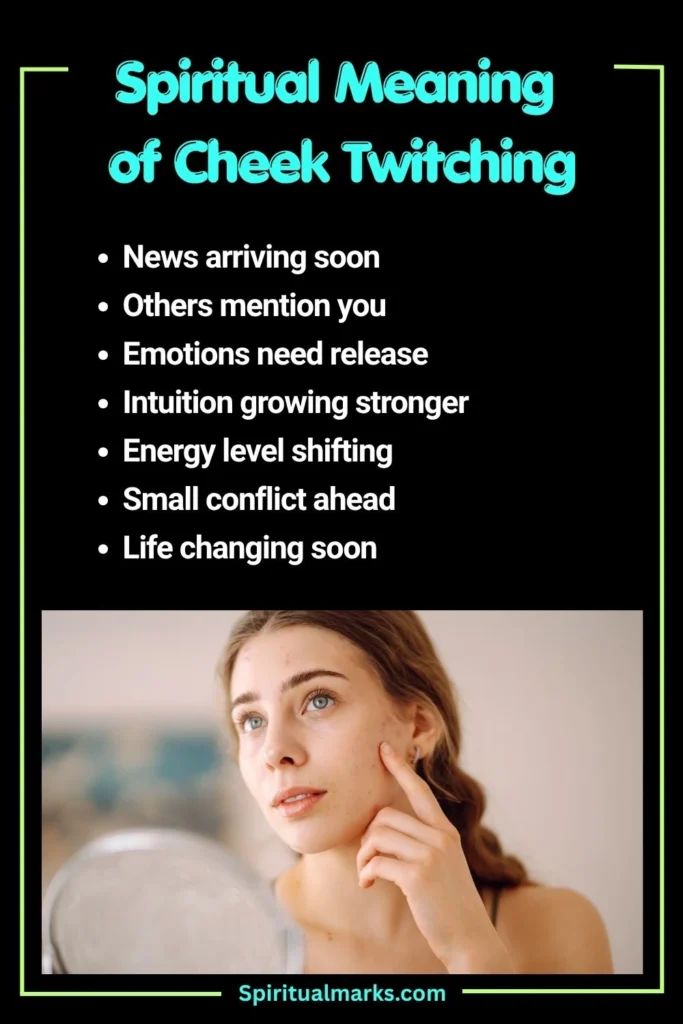
1. Incoming News or Communication
In many traditions, the face acts as a sensory bridge between the internal and external worlds. When a cheek twitches, it is sometimes seen as an energetic alert that something is on its way to you. Not physically yet, but already forming in the unseen layers of interaction.
This idea rests on the belief that human connection does not begin at the moment of contact. It begins earlier, at the level of intention. When someone thinks about reaching out, making a decision, or delivering news, that intention carries a subtle energetic signature. Sensitive systems, especially during quiet or distracted moments, may register this shift before it materializes.
People often report that these twitches occur during neutral states. You are not expecting anything. Then later, a message arrives, a call comes through, or unexpected information surfaces. Whether coincidence or subtle awareness, the experience creates a sense that the body knew something before the conscious mind did.
2. Someone Thinking or Speaking About You
This interpretation appears across cultures in different forms. The core idea remains consistent. When attention is directed toward you, your energy field responds.
The cheek holds symbolic significance here because it relates closely to expression, communication, and social identity. When someone speaks your name, thinks intensely about you, or even discusses you in your absence, some traditions suggest that a subtle energetic link forms. The twitch becomes a physical echo of that connection.
Interpretations often split along emotional lines. A left cheek twitch may point toward hidden thoughts or unspoken feelings. A right cheek twitch may align with direct conversation or outward attention. While these distinctions vary by culture, they share a common thread: your body reacting to relational energy.
This belief highlights how deeply humans associate physical sensation with social awareness. Even if one approaches it metaphorically, it reflects a broader truth. We are deeply attuned to how others perceive and engage with us, often in ways we do not consciously track.
3. Emotional Imbalance Seeking Release
The face carries emotional weight more than almost any other part of the body. It expresses joy, tension, frustration, and vulnerability in real time. When emotions remain unprocessed, they do not simply disappear. They settle, linger, and sometimes surface through subtle physical cues.
A cheek twitch, in this context, becomes a small release valve. It signals that something beneath the surface is seeking movement. Not necessarily something dramatic, but perhaps something unresolved. A conversation left unfinished. A feeling pushed aside. A reaction you chose not to express.
Spiritual interpretations frame this as the body assisting in emotional regulation. Instead of allowing energy to stagnate, it releases small amounts through involuntary movement. The twitch becomes less about disturbance and more about gentle correction.
Many people notice that these twitches appear during periods of emotional buildup. Busy schedules, internal stress, or prolonged silence around certain feelings often precede them. The body, in its own quiet way, refuses to hold everything indefinitely.
4. Intuitive Awakening or Heightened Awareness
During periods of personal growth, the body often becomes more sensitive. You might notice changes in sleep patterns, emotional responses, or sensory awareness. Within spiritual frameworks, cheek twitching sometimes appears as part of this heightened sensitivity.
The idea centers on the expansion of intuitive perception. As awareness deepens, subtle shifts in energy become more noticeable. The nervous system responds differently, sometimes producing small physical reactions as it adapts.
In this interpretation, the twitch acts as a byproduct of increased receptivity. It is not the message itself, but a sign that your internal system is tuning into finer signals. People going through phases of introspection, meditation, or personal transformation often report similar experiences.
This perspective does not frame the twitch as a warning or prediction. Instead, it places it within a broader narrative of growth. The body and mind recalibrating together.
5. A Shift in Personal Energy or Vibration
Energy-based traditions often describe human experience in terms of frequency and alignment. When your internal state changes, whether through healing, insight, or external influence, your energetic baseline shifts.
A cheek twitch, in this context, reflects adjustment. It marks a moment where old patterns release and new ones settle in. The sensation may feel minor, yet it represents a transition happening beneath conscious awareness.
These shifts do not always feel dramatic. Sometimes they occur quietly, following small realizations or subtle changes in perspective. You might feel slightly different without being able to explain why. The twitch becomes one of the few physical indicators that something has shifted internally.
People who engage in practices focused on balance, such as mindfulness or energy work, often interpret these moments as signs of recalibration rather than disruption.
6. Warning of Minor Conflict or Misunderstanding
In more caution-oriented interpretations, cheek twitching serves as a gentle signal to pay attention to communication. The face, being central to expression, becomes a logical focal point for warnings related to interaction.
This meaning does not suggest major conflict. Instead, it points toward small misunderstandings, misread tones, or overlooked details in conversation. The twitch acts as a prompt to slow down and become more intentional in how you speak and listen.
Many traditions view such signals as protective rather than predictive. They do not indicate that something negative will happen. They suggest that awareness can prevent unnecessary friction.
This interpretation resonates with everyday experience. Moments of miscommunication often arise not from major disagreements, but from small lapses in clarity. The idea that the body signals this possibility adds another layer to how people understand interpersonal awareness.
7. Anticipation of Change or Movement in Life
Change rarely arrives without subtle buildup. Before decisions become visible, there is often a period of quiet momentum. Energy shifts, thoughts reorganize, and circumstances begin aligning behind the scenes.
Cheek twitching, in this view, reflects that early stage of movement. It signals that something is in transition, even if it has not fully taken shape yet. This could relate to relationships, work, personal direction, or internal mindset.
People who notice this pattern often describe a sense of restlessness or anticipation around the same time. The twitch becomes one small piece of a larger picture, hinting that life is preparing to move in a new direction.
This emphasizes timing. It suggests that the body sometimes recognizes change before the conscious mind feels ready to acknowledge it.
8. Reflection of Suppressed Thoughts or Feelings
Not all inner experiences reach the surface easily. Some thoughts remain unspoken. Some feelings stay hidden, either by choice or habit. Over time, these suppressed elements create subtle pressure within the mind and body.
A cheek twitch, from this perspective, acts as a release point. It reflects internal tension that has not found expression elsewhere. The face, closely tied to identity and communication, becomes the outlet.
This interpretation aligns with psychological observations as well. Suppression often leads to physical manifestations, even if minor. The twitch becomes a reminder that what is unspoken still exists and seeks acknowledgment.
Rather than framing this as negative, many see it as a sign of awareness beginning to surface. The body signaling that something is ready to be recognized.
9. Spiritual Nudging Toward Attention or Mindfulness
Modern life moves quickly. Attention scatters across tasks, screens, and responsibilities. In that constant motion, subtle signals often go unnoticed.
Within spiritual frameworks, cheek twitching sometimes represents a pause signal. A moment where the body interrupts routine to bring attention back to the present. Not through words or thoughts, but through sensation.
This interpretation frames the twitch as a gentle nudge. It invites awareness without forcing it. When the sensation appears, it creates a brief interruption. A space where you can notice your surroundings, your thoughts, or your emotional state.
People who resonate with this meaning often describe a sense of clarity following the moment. Not because the twitch delivers a direct message, but because it creates space for attention to return.
Cheek Twitching Spiritual Meanings in Different Cultures, Countries or Religions
Across cultures, cheek twitching rarely appears as a random event. Instead, it often carries symbolic meaning shaped by tradition and belief.
In Chinese culture, facial twitching falls under a broader system of body omens. Each part of the face links to specific outcomes based on time and location. A twitch in the cheek may signal incoming news, financial shifts, or social interactions depending on the exact timing.
Indian traditions, especially those rooted in astrology and folklore, also assign meaning to facial movements. Many believe that right-sided twitches bring favorable outcomes for men but not always for women. These interpretations reflect deeper cultural narratives around energy and polarity.
African folklore often connects body twitching with spiritual communication. In some communities, cheek twitching suggests that someone speaks about you, either positively or negatively. This belief reinforces the idea that social energy can travel beyond direct interaction.
Similarly, in Western superstition, facial twitching sometimes links to stress or nervous energy, yet older beliefs hint at symbolic meanings. Some traditions suggest that a twitch indicates upcoming encounters or emotional shifts.
In Japanese culture, subtle body movements often tie to awareness and internal balance. While not always framed as superstition, a twitch may encourage mindfulness and reflection on one’s emotional state.
Middle Eastern interpretations sometimes associate facial twitching with unseen energies or spiritual presence, especially when it occurs repeatedly or at unusual times.
Right Cheek Twitching Superstition and Spiritual Meaning
Right cheek twitching often carries positive connotations in many traditions. People commonly associate it with favorable outcomes or uplifting interactions.
It may signal that someone speaks well of you. This belief appears in multiple cultures, where the right side represents positivity, alignment, and outward harmony. When your right cheek twitches, it can suggest approval or admiration from others.
Some traditions connect it with good news. You may receive a message, invitation, or opportunity that brings progress or joy. The timing of the twitch often shapes the interpretation further.
Right cheek twitching can also reflect confidence building within you. It may indicate that you are stepping into a phase where your actions align with your intentions.
Another interpretation ties it to social success. You may soon engage in conversations or situations that strengthen your relationships or reputation.
Left Cheek Twitching Superstition and Spiritual Meaning
Left cheek twitching often carries more complex interpretations. While not always negative, it tends to signal caution or emotional depth.
Many traditions link it to gossip or criticism. Someone may speak about you in a way that lacks positivity or honesty. This idea reflects the symbolic association of the left side with introspection and hidden dynamics.
It can also point to emotional imbalance. You may be holding onto stress, frustration, or unresolved thoughts that need attention.
Some beliefs suggest it warns of minor conflict. This does not indicate major issues but encourages awareness in communication and interactions.
At times, left cheek twitching represents internal reflection. You may need to pause and reassess your current situation, especially if you feel uncertain or overwhelmed.
Spiritual Meaning of Cheek Twitching For Females
For females, cheek twitching often connects to emotional awareness and social energy. Many traditions place emphasis on sensitivity and intuition, shaping how these signs get interpreted.
It may indicate emotional processing. You could be navigating feelings that have not yet surfaced fully, and the twitch acts as a subtle signal.
Some beliefs suggest it relates to relationships. You may experience shifts in how you connect with others, whether through communication or emotional understanding.
In certain traditions, a twitch signals incoming news that affects personal life rather than external achievements.
It can also reflect heightened intuition. Females often get associated with stronger intuitive awareness in spiritual narratives, making such signs more connected to inner knowing.
Another interpretation points to self-expression. You may feel the need to speak your truth or share thoughts you have been holding back.
Spiritual Meaning of Cheek Twitching For Males
For males, cheek twitching often links to action, reputation, and external events. Traditional interpretations reflect societal roles tied to decision-making and public presence.
It may signal upcoming opportunities. You could encounter situations that require quick thinking or assertive action.
Some beliefs connect it to social standing. A twitch might indicate that others discuss your actions, decisions, or achievements.
It can also point to internal tension. While not always expressed openly, emotional stress may manifest physically in subtle ways.
In certain traditions, right cheek twitching for males suggests success, while left cheek twitching indicates caution in decisions.
Another interpretation links it to communication. You may need to address something directly rather than avoid it.
Cheek Twitching for Female is Good or Bad?
The answer depends heavily on context. Cultural beliefs often assign different meanings, but they rarely agree completely.
In some traditions, right cheek twitching for females does not carry the same positive meaning it does for males. It may instead suggest emotional sensitivity or social tension. On the other hand, left cheek twitching might indicate reflection rather than negativity.
Rather than labeling it strictly as good or bad, many modern interpretations treat it as neutral. It becomes a signal rather than a prediction. The meaning depends on your emotional state, environment, and personal intuition at that moment.
This perspective allows you to interpret the experience in a way that feels relevant rather than restrictive.
Table: Spiritual Meaning of Cheek Twitching
| Aspect | Interpretation |
|---|---|
| Right Cheek | Positive news, praise, social success |
| Left Cheek | Gossip, emotional tension, caution |
| Females | Emotional awareness, intuition, relationship shifts |
| Males | Action, reputation, external opportunities |
| General Meaning | Communication, energy shift, awareness |
| Cultural View | Symbolic sign linked to social or spiritual messages |
A Final Note
Cheek twitching sits at an interesting intersection between biology and belief. On one side, science explains it as a simple muscle reaction. On the other, tradition layers it with meaning, symbolism, and intuition. Both perspectives can exist without canceling each other out.
If you experience cheek twitching, pay attention to your surroundings, emotions, and recent interactions. Patterns often reveal more than isolated moments. At the same time, avoid letting superstition create unnecessary worry or expectation.
Balance remains key. You can respect cultural meanings while staying grounded in your own experience. When you approach it this way, even the smallest twitch becomes a moment of awareness rather than confusion.
References
- https://www.spiritualmarker.com/cheek-twitching-superstition-spiritual-meaning/
- https://www.tiktok.com/@xoxoshardae/video/7437378916177808683
- https://www.youtube.com/watch?v=qhWyaLng6ao
- https://www.meaningfulspirit.com/cheek-twitching-superstitions-and-spiritual-meanings/
- https://www.angelicalbalance.com/spirituality/left-and-right-cheek-twitching-superstition/
- https://www.youtube.com/watch?v=3Xr6nAbfa9o
- https://www.pinterest.com/pin/left-right-cheek-twitching-meanings-superstition–64387469666830072/